
Seattle families often assume the city’s tech reputation is the whole story. Instead, the more useful advantage sits one layer down, in a real concentration of cancer research centers, biotech labs, maritime agencies, and independent media institutions. Notably, several of them keep their doors open to current high schoolers, not just college interns. For students willing to apply early and commit for real, that access can shape a transcript in ways a course catalog alone cannot.
Where Seattle Sits in the Admissions Landscape
Washington does not send elite colleges the volume of applicants that California or the Northeast does. As a result, Seattle students are not swimming in as crowded a regional pool. That said, this modest advantage only helps students who already have a strong record. Geography does not rescue a thin application.
The University of Washington’s strength creates its own gravitational pull. UW is affordable and highly regarded, especially in engineering, computer science, and public health. Many families default to it as the safety option and stop building a broader list. That instinct is understandable. However, it can also mean students underexplore Early Decision, a tool that meaningfully raises odds for a genuine first choice. Applying ED signals commitment at the exact moment admissions offices are shaping their class.
The City’s Research Engine
Seattle’s biomedical sector is, by a wide margin, the city’s most distinctive academic asset. Fred Hutchinson Cancer Center, Seattle Children’s Research Institute, and the Institute for Systems Biology all run structured, verified programs built specifically for high schoolers. That is unusual for a research cluster of this caliber.
Biomedical Research, Three Ways
Fred Hutch’s Summer High School Internship Program (SHIP) is an eight-week, full-time paid internship on the Fred Hutch campus in South Lake Union. It targets students entering senior year who are at least 16 by the start date. Applicants must currently live in Greater Seattle or the surrounding area. Interns spend two weeks on lab safety and technique training, then join a research group for six weeks. In turn, they receive a stipend plus a free ORCA card for commuting.
Seattle Children’s Research Institute offers a shorter, related option. Its Research Training Program runs four weeks and is open to current 10th and 11th graders. Students cover biochemistry, immunology, public health, and infectious disease through hands-on lab work.
By contrast, the Institute for Systems Biology runs an eight-week, roughly 300-hour internship for current juniors through its Baliga Lab. Topics include computational biology, microbiology, and engineering. Unlike the other two programs, ISB also offers a full academic-year track for seniors whose schools grant release time. It also runs a six-week virtual DREAM-High collaboration with Columbia University and Stanford, focused on genomics data analysis. Both paid and unpaid tracks exist, and the summer cohort runs from late June through late August.
Beyond the Lab: Civic, Maritime, and Media Access
Not every strong applicant is headed toward a science major, and Seattle’s opportunities reflect that. The Port of Seattle’s High School Internship Program has run since 1963. It places students 16 and older across aviation operations, maritime operations, governance, civic engagement, and environmental work. Applicants must be currently enrolled in high school, recently graduated within the past 12 months, or completing a GED program. The summer cycle opens each May, and a winter cycle opens each November.
For students drawn to media instead of policy, KEXP’s Youth Radio Program offers a different kind of access. The free program is open to musically passionate students ages 15 to 18 in the Seattle-Tacoma metro area. It combines six weeks of in-person class instruction with ongoing mentorship from KEXP DJs. Participants who finish training join a rotating team of hosts for 90.TEEN, the station’s youth-produced show. They also receive a $150 stipend for the class portion, plus $30 for every show they help produce.

What Makes Seattle Distinctive
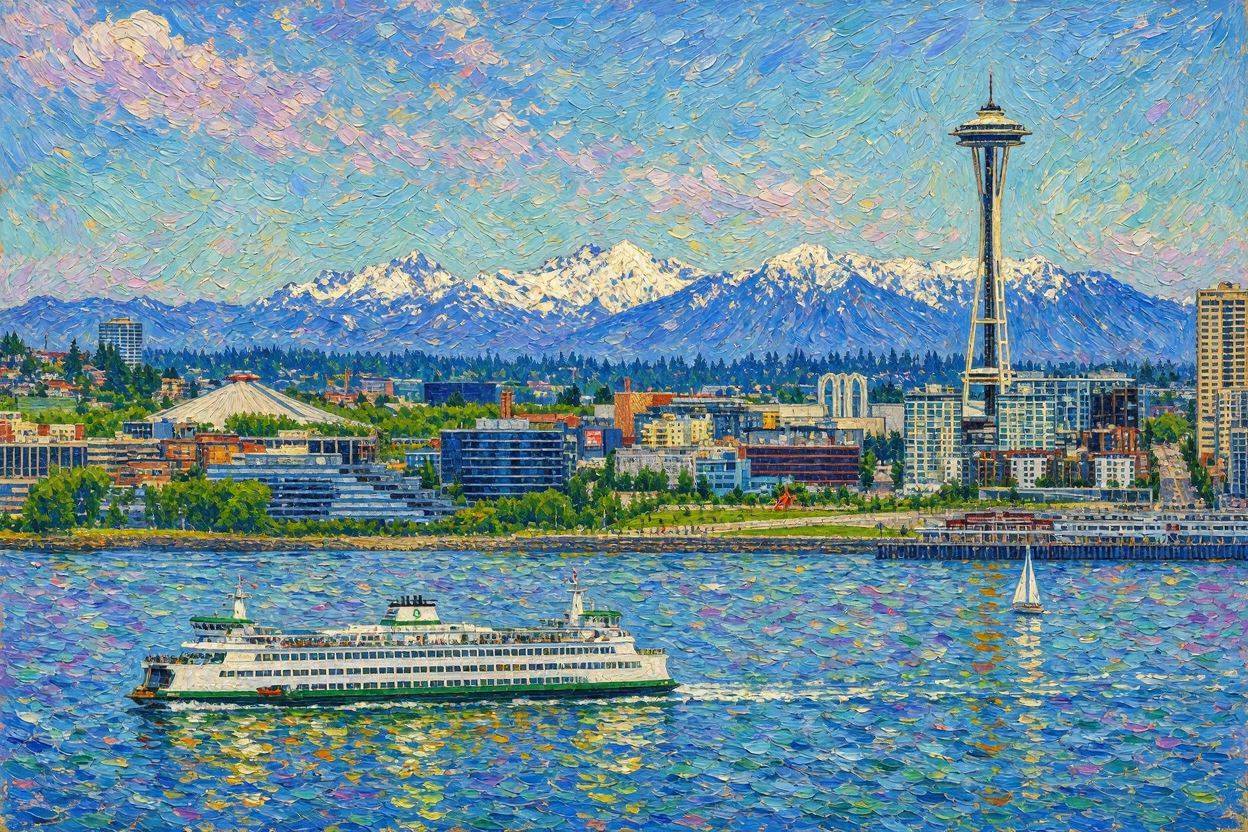
Seattle’s essay material extends well past its research institutions. The city sits on Puget Sound, and its relationship to water shows up everywhere. For example, the Ballard Locks connect fresh and saltwater ecosystems, and the ferry system functions as genuine daily infrastructure rather than tourist novelty. Beyond that, ongoing salmon-recovery work in the region ties environmental science to civic policy in ways students can observe directly.
Seattle’s independent music scene is another distinctive thread. Anchored by KEXP and the all-ages venues that grew out of the city’s grunge history, it gives students a cultural throughline for essays about identity and community. The tech economy, similarly, is not abstract background noise. Amazon, Microsoft’s nearby Redmond campus, and a dense startup ecosystem mean many students have direct or family exposure to the industry. That exposure can sharpen an essay, but only when it is handled with specificity instead of generic enthusiasm.
Turning Access into a Competitive Application
None of these programs matter much in isolation. Admissions readers respond to depth. A student who spends two consecutive summers at Fred Hutch, or who moves from KEXP’s Youth Radio Program into a genuine on-air role, tells a more convincing story than one with a single unconnected internship. By contrast, a scattered list of one-time activities rarely reads as commitment, however impressive each individual line looks on its own.
Seattle also rewards students who look slightly beyond city limits. Bellevue’s biotech corridor, the University of Washington’s own pre-college offerings, and Tacoma’s port and manufacturing base extend the same logic of local, verified access across the broader Puget Sound region. Students who build a genuine record in one of these areas, and who write about it with real precision, put together an application that a strong local list alone cannot produce. College Transitions works with Seattle-area students to identify which of these opportunities fit their actual interests, and to build that experience into an application that holds together from freshman year through the final essay.

