
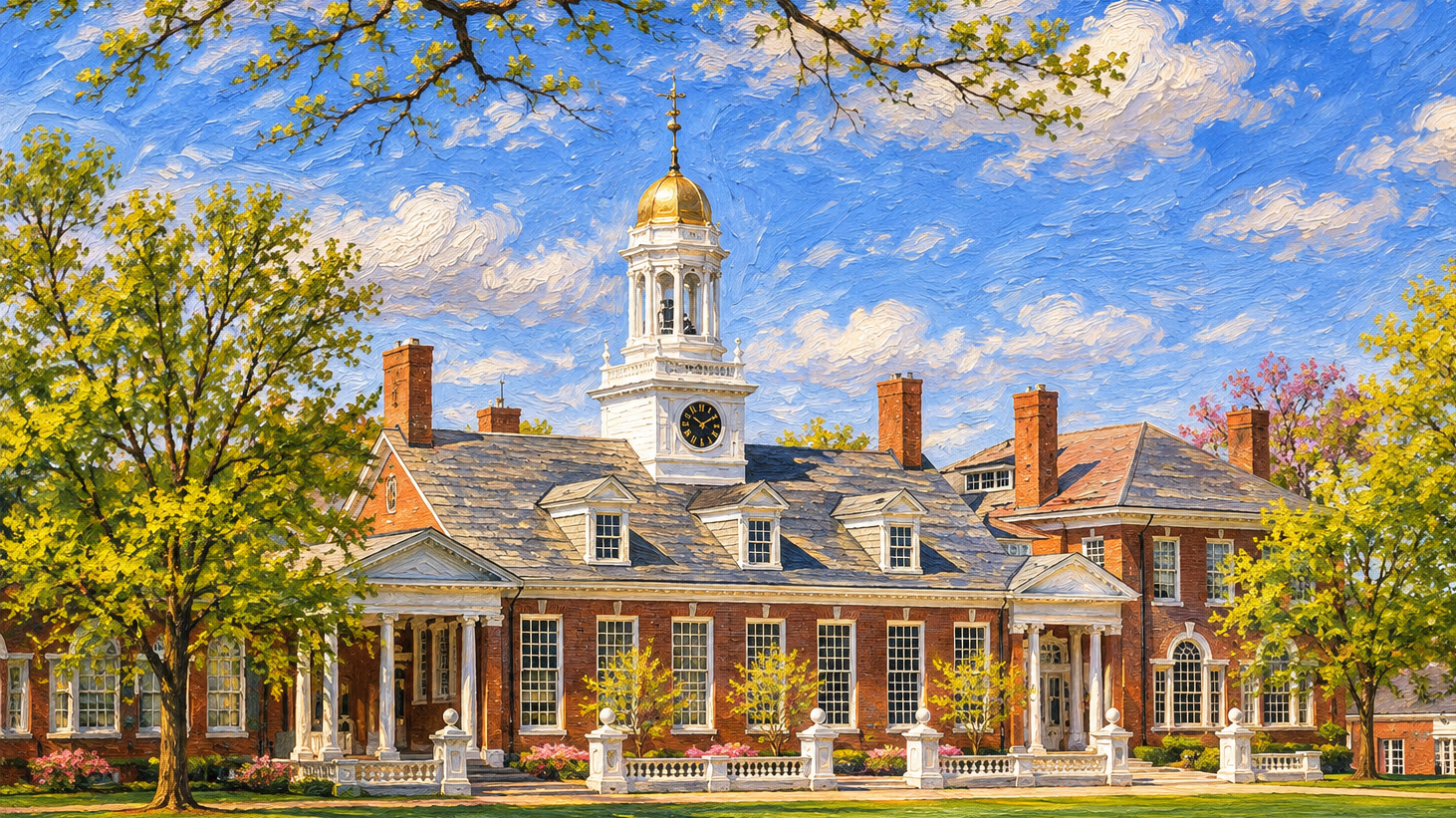
Between 2022 and 2026, 58 Groton School graduates enrolled at the University of Chicago. Harvard, Yale, Princeton, and Stanford together enrolled 54. UChicago is Groton’s largest reported destination by a wide margin, and it is the first thing a reader notices on Groton’s matriculations page. Its 58 enrollments are 21.5% of the 270 that Groton reports by count; its share of all graduates cannot be calculated from this thresholded list.
We did not locate a public copy of Groton’s profile for colleges, but the school publishes a good deal elsewhere: exact counts for every college with five or more enrollees over five years, a Fast Facts page with test averages and AP results, a detailed tuition and aid page, and a 62-page academic policies and course catalog. This look at Groton college matriculation and academics is built from those sources. Calculated figures are marked as ours, and figures we could not locate in official sources are left blank.
For context on Groton’s peers, see our list of the best boarding schools in the US and our directory listing for Groton School.
Groton at a Glance
Each row carries its source. Figures are from Groton’s website as of November 2026.
| Measure | Figure | Source |
| Total enrollment | 380 students, grades 8 through 12 | Fast Facts page |
| Boarding | 84% boarding, 16% day | Fast Facts page |
| Faculty | 90; 4:1 student-faculty ratio; 76% with advanced degrees | Fast Facts page |
| Average class size | 11 | Fast Facts page |
| Geographic reach | 32 states and 24 countries | Fast Facts page |
| Students of color / international | 56% / 16% | Fast Facts page |
| Tuition, 2026–27 | $62,740 boarding; $48,850 day; plus a $600 technology fee and a $400 boarding health fee | Fast Facts and tuition pages |
| Financial aid, 2026–27 | 40% of students; average boarding grant $52,639; average day grant $36,892 | Fast Facts and tuition pages |
| Endowment | $611 million | Fast Facts page |
| Grading | Numerical, 50–100; below 60 is failing | Course catalog, 2026–27 |
| Class rank | Not located in the public sources reviewed |
Groton describes itself as the leader in tuition cost containment among American boarding schools. Within this series, its posted 2026–27 boarding tuition is the lowest of the six schools profiled so far: Lawrenceville, Deerfield, Andover, Choate, Exeter, and Groton. The comparison is base tuition only; schools include different fees, and most aided families pay far less.
Chart 1. Published 2026–27 boarding tuition at the six schools profiled in this series.
[Interactive version for WordPress: replace this line with the iframe for groton-chart-1.html from chart-embeds.html]
The tuition and affordability page adds that, beginning in 2025, tuition is free for students whose family income is $150,000 or less, for domestic and international families alike, provided assets are in line with income. Groton says it does not consider a family’s financial circumstances in admission decisions, and that aid extends beyond tuition to summer study, travel, books, and laptops. The average boarding family contribution for 2026–27 is $10,101.
The same page publishes a table of aided families by income and expected contribution. In the lowest bracket (family income up to $75,000), 25 of 32 aided families contribute $5,000 or less. The table needs care, though: in three of its five income rows, the cells do not add up to the row totals Groton prints, so we report it only at that level of detail.
We did not locate an official acceptance rate and have not reported one.
How Groton Reports College Outcomes
Groton’s matriculations page lists colleges where five or more Groton students matriculated between 2022 and 2026, with an exact count for each. The 23 counted colleges account for 270 enrollments. The page also publishes an uncounted list of additional destinations with fewer than five. That list contains duplicate and overlapping entries (Hamilton and Williams also appear on the counted list, William & Mary appears under two names, and Oberlin’s college and conservatory are listed separately), so we do not treat it as a clean count of distinct colleges.
We did not locate graduating class sizes in the public sources reviewed, so we have not converted the 270 enrollments into a share of graduates.
Where Groton Graduates Enroll
Chart 2. Colleges where five or more Groton graduates enrolled, 2022–2026.
[Interactive version for WordPress: replace this line with the iframe for groton-chart-2.html from chart-embeds.html]
After UChicago, the list is led by Harvard (18), Tufts (16), and Boston College, Dartmouth, and Yale (14 each). All eight Ivy League universities have five or more, and together they enrolled 95 Groton graduates. Princeton and Stanford enrolled 11 each. The liberal arts colleges on the counted list are all in the Northeast: Middlebury (9), Colby and Hamilton (7), Williams (6), and Bowdoin and Colgate (5).
The uncounted list is notable for who is on it. MIT, Duke, NYU, Northeastern, Notre Dame, Michigan, UVA, WashU, and Amherst appear there, meaning each enrolled fewer than five Groton graduates over the five years. Johns Hopkins does not appear on either list.
For more on three of the colleges at the top of Groton’s list, see our guides on how to get into the University of Chicago, how to get into Harvard, and how to get into Tufts.
UChicago Across the Series
Groton is not the only school in this series with a large UChicago count. Choate enrolled 66 graduates there over the same five classes, according to its 2026–2027 School Profile. Lawrenceville’s current five-year list, whose classes are not specified, shows 21, and Deerfield places UChicago in its 10-to-19 band.
Chart 3. Five-year UChicago enrollments by school; current enrollment shown as context only.
[Interactive version for WordPress: replace this line with the iframe for groton-chart-3.html from chart-embeds.html]
The chart shows each school’s current total enrollment as context only. Those totals cover different grades (Groton’s includes eighth graders) and are not graduating-class denominators, so the lists cannot be turned into comparable rates. The lists also cannot explain the counts; they do not show the roles of applicant interests, application patterns, affordability, athletic recruitment, or other factors. In a school of Groton’s size, a handful of students in one year can move a five-year total.
Grades and Academic Recognition
Groton grades every course numerically, from 50 to 100, in whole numbers; the school does not give a term or year grade below 50, and anything below 60 is failing. Grade reports include narrative comments from teachers, and at the end of the fall and spring terms, a letter from the student’s advisor.
We did not locate a GPA distribution. The 2026–27 academic policies and course catalog (printed page 8) defines the cumulative Upper School averages, calculated across the Fourth, Fifth, and Sixth Form years without rounding, that make a student eligible for a diploma with distinction:
| Diploma | Eligibility range as printed |
| Cum laude | 86–88 |
| Magna cum laude | 89–92 |
| Summa cum laude | 92.5 or higher |
We report the ranges as the catalog prints them. The catalog does not say how many students earn each distinction. Honor and Merit Lists recognize students only in the Second, Third, and Fourth Forms; there is no list for the two upper forms.
The Curriculum
Groton’s forms run from the Second Form (eighth grade) through the Sixth Form (twelfth grade). Students take five full-credit courses on a three-term calendar; a full course meets 180 to 240 minutes a week, usually in four 45-minute meetings. Expected homework rises with each form, from about 30 minutes per class meeting in the Second and Third Forms to about 60 in the Sixth. Latin is central: every student who enters in the Second or Third Form takes it.
Diploma requirements for the four high school years, according to the catalog, include English through the fall of the Sixth Form; mathematics through precalculus or the Fifth Form, whichever comes later; two years of laboratory science; Modern Global History and U.S. History; a one-term religion course; three credits of art plus a Third Form art; and at least three years of language.
Unlike Exeter, which offers no AP courses, and Deerfield, which has moved away from them, Groton still offers AP courses in several departments, including AP Calculus AB and BC, AP Statistics, AP Computer Science, AP Biology, AP Chemistry, AP Latin, AP Music Theory, and AP language courses in Chinese, French, and Spanish. Other courses, such as U.S. History and Fifth Form English, are taught at a level that prepares students for the AP exam. Beyond the AP sequence, the catalog lists Multivariable Calculus, Linear Algebra and Cryptography, Advanced Probability, Data Structures and Advanced Programming, Organic Chemistry, and Advanced Ancient Greek.
Two Sixth Form programs stand out. Tutorials let seniors with strong backgrounds pursue advanced work not otherwise offered; recent topics on Groton’s curriculum page include Abstract Algebra, Fluid Dynamics, and Computational Linguistics. In the spring Intensive Program, a senior keeps one regular course and spends the rest of the term, about 30 hours a week, on a self-designed program in one area, contracted with a faculty member in three-week segments.
Testing and AP Results
Groton’s Fast Facts page reports averages rather than ranges: an average SAT composite of 1470 and an average ACT composite of 34 for the Form of 2026. It does not say how many students tested or whether the averages cover every student. Under the heading “Form of 2027,” the page reports 531 total AP exams, “99% Students with Scores of 3, 4, or 5,” and “92% Students with Scores of 4 or 5.” The page does not define the testing period behind the 531 exams or the student denominator for the percentages, so we report them as labeled. Our guide to what counts as a good ACT score offers national benchmarks.
College Counseling at Groton
According to Groton’s college counseling page, counselors begin group information sessions, individual meetings with students and parents, and parent presentations in the winter of the Fifth Form (junior year). In the Sixth Form, students continue individual meetings and can meet more than 100 college representatives who visit campus. Groton registers all students for the PSAT, and most Fifth Formers take the SAT in December or May. The school also publishes a planning calendar that runs from the Third through the Sixth Form.
We did not locate a list of counselors or counselor caseloads in the public sources reviewed, and we have not estimated either.
Does Groton Raise Your Odds at Selective Colleges?
Groton’s list shows that its graduates enroll at highly selective colleges in large numbers, and at UChicago in exceptional numbers. It does not show that attending Groton caused those outcomes. Groton is highly selective itself, and where its graduates enroll reflects financial aid, binding early decision, athletic recruiting, legacy ties, and personal preference, none of which the list separates out. In a school this small, a single class can also tilt a five-year total. School publications do not provide a matched comparison of otherwise similar applicants, so strong outcomes and an admissions advantage remain different claims.
A Counselor’s Read for Groton Families
The points below are College Transitions’ professional interpretation. They are consistent with Groton’s published data but not proven by it.
Read the UChicago figure as information about past classes, not about any one student. The five-year total does not establish any individual applicant’s admission probability.
Understand the numerical transcript. Groton reports grades on a 100-point scale, and its counseling office can explain how the transcript and any profile sent to colleges present them.
Use the full list. The uncounted list includes many highly selective colleges, and a low or absent count is not enough evidence about fit or a student’s realistic chances.
Frequently Asked Questions
Which colleges enroll the largest numbers of Groton graduates?
From 2022 through 2026, the University of Chicago enrolled 58 Groton graduates, followed by Harvard (18), Tufts (16), and Boston College, Dartmouth, and Yale (14 each).
How much does Groton cost?
Boarding tuition for 2026–27 is $62,740 and day tuition is $48,850, plus small technology and health fees. Tuition is free for families earning $150,000 or less whose assets are in line with their income.
Does Groton offer AP classes?
Yes. AP courses are offered in several departments, including math, science, computer science, Latin, modern languages, and music theory.
How does Groton grade?
Numerically, from 50 to 100. The catalog makes students eligible for diplomas with distinction at cumulative Upper School averages of 86–88 (cum laude), 89–92 (magna cum laude), and 92.5 or higher (summa cum laude).
Methodology
Sources: Groton’s matriculations, college counseling, Fast Facts, tuition and affordability, and curriculum pages, and its 2026–27 Academic Policies and Course Catalog (the edition dated October 15, 2026 on its cover). The UChicago comparison uses Choate’s 2026–2027 School Profile (Classes of 2022–2026), Deerfield’s School Profile 2026–2027 (2022–2026, banded), and Lawrenceville’s current five-year list (classes not specified). All sources were accessed November 12, 2026.
Groton’s five-year list covers 2022 through 2026. Test averages describe the Form of 2026 and AP results the Form of 2027. Enrollment, aid, and tuition figures describe 2026–27. The 21.5% figure is UChicago’s share of the 270 counted enrollments only. We did not locate a profile for colleges, a GPA distribution, counselor caseloads, admission results, graduating class sizes, or an acceptance rate in the public sources reviewed, and we have not estimated any of them.
Groton is part of a series of data-driven school profiles. You can browse our other data visualizations.
Appendix: Groton’s Five-Year College List, 2022–2026
The 23 colleges where five or more Groton graduates enrolled, with CT’s grouping. The full list of colleges with fewer than five appears on Groton’s matriculations page.
| College | Enrolled, 2022–2026 | CT group |
| University of Chicago | 58 | Other private universities |
| Harvard University | 18 | Ivy League |
| Tufts University | 16 | Other private universities |
| Boston College | 14 | Other private universities |
| Dartmouth College | 14 | Ivy League |
| Yale University | 14 | Ivy League |
| Georgetown University | 12 | Other private universities |
| Cornell University | 11 | Ivy League |
| Princeton University | 11 | Ivy League |
| Stanford University | 11 | Other private universities |
| Brown University | 10 | Ivy League |
| Columbia University | 9 | Ivy League |
| Middlebury College | 9 | Liberal arts colleges |
| University of Pennsylvania | 8 | Ivy League |
| Colby College | 7 | Liberal arts colleges |
| Hamilton College | 7 | Liberal arts colleges |
| Northwestern University | 7 | Other private universities |
| Carnegie Mellon University | 6 | Other private universities |
| University of Southern California | 6 | Other private universities |
| Vanderbilt University | 6 | Other private universities |
| Williams College | 6 | Liberal arts colleges |
| Bowdoin College | 5 | Liberal arts colleges |
| Colgate University | 5 | Liberal arts colleges |
If your family is weighing how a school like Groton shapes a college list, or you want an outside read on a transcript from a demanding school, our college admissions counselors work with students at every stage of high school.

