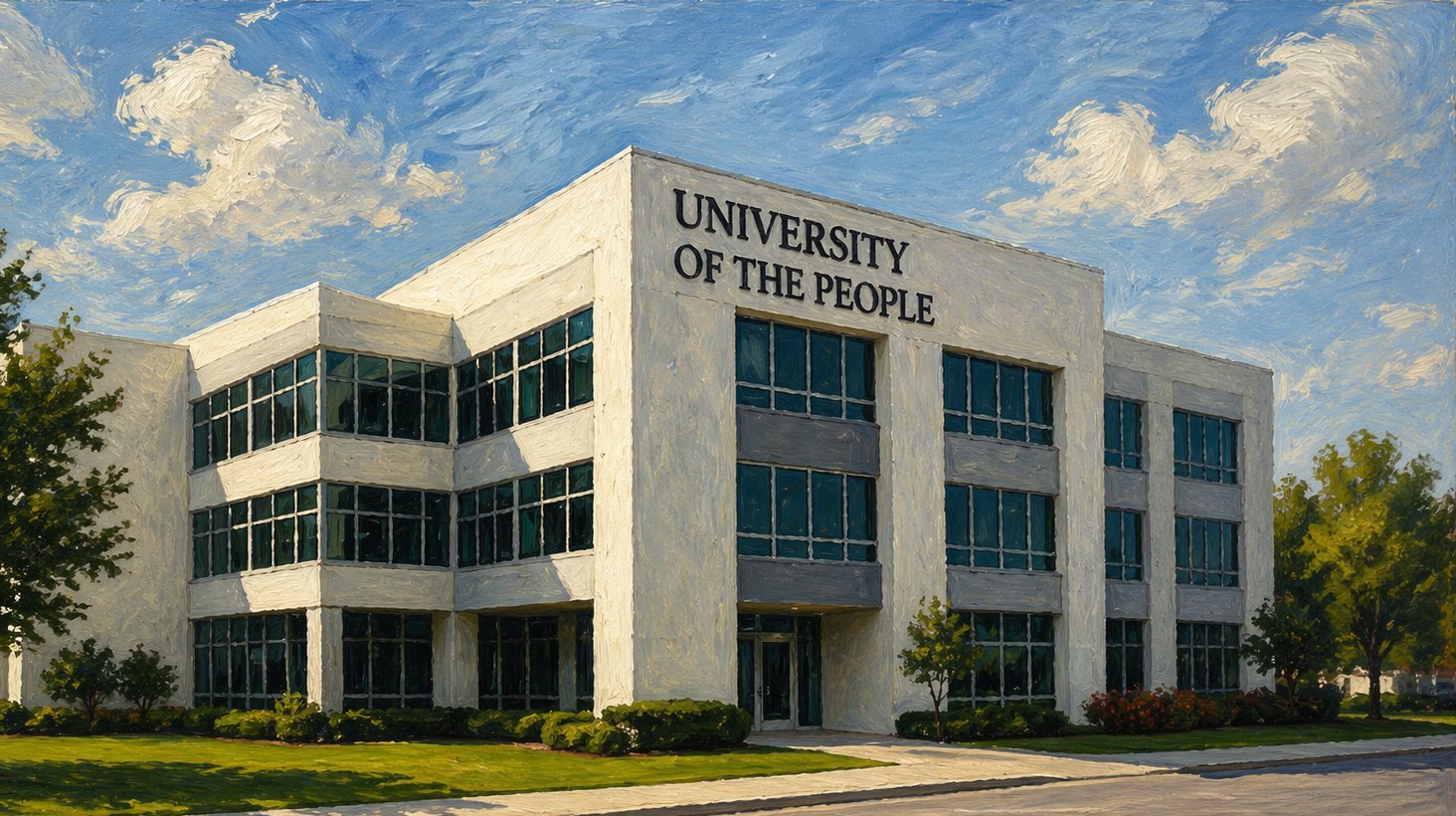
University of the People (UoPeople) is a private, nonprofit, accredited online university headquartered in Pasadena, California and founded in 2009 by Shai Reshef. It operates under a distinctive tuition-free model: students pay no tuition, only a one-time application fee and modest per-course assessment fees. The result is that a completed bachelor’s degree at UoPeople can cost under $5,000 total, a figure that is roughly 90% below the average in-state four-year public tuition in the United States and substantially below any other accredited online bachelor’s pathway available to adult learners.
UoPeople is not a typical US online university, and evaluating it requires understanding what tuition-free actually means, what the recent accreditation transition changed, and what tradeoffs students accept in exchange for the low cost. This review walks through all three. For the broader adult learner framework on evaluating any online institution, see: The Complete Guide to Earning an Accredited Online Degree as an Adult Learner.
What Tuition-Free Actually Means at UoPeople
The tuition-free model is the single most important thing to understand about UoPeople before enrolling. It is real, not marketing, but it requires specific framing to understand what students actually pay and why the total cost still runs several thousand dollars despite the label.

What students pay
UoPeople charges a one-time, non-refundable application fee of $60 at the point of admission. After admission, students pay an assessment fee at the end of each course they complete. The assessment fee is $160 per course for undergraduate programs, $400 per course for the Master of Education, and $450 per course for the MBA and MS in Information Technology. Students who complete a full associate degree (20 courses) pay approximately $3,260 total. Students who complete a full bachelor’s degree (40 courses) pay approximately $6,460 total. An MBA or M.Ed. typically runs $5,260 to $5,460 total depending on program.
These figures are final degree costs, not annual tuition. There are no textbook fees (UoPeople uses open educational resources), no campus fees, no technology fees, no enrollment fees, and no per-term bills that accumulate regardless of course completion. The pay-as-you-complete structure means a student who takes a slow pace pays over a longer timeline but does not pay more in total.
Why the label matters
The word tuition-free is sometimes used by competitor institutions to market pricing that is simply low rather than genuinely unlike traditional tuition. UoPeople’s model is genuinely different: the per-course fee functions more like a testing or certification fee than like tuition, and it is charged only at the point of course completion. For students who need to pause, step away, or take a term off, the structure is substantially more forgiving than traditional semester-based tuition that continues to accumulate regardless of attendance.
UoPeople Total Degree Cost Summary
| Program | Courses | Fee Per Course | Estimated Total |
| Associate degree (2 years) | 20 | $160 | $3,260 |
| Bachelor’s degree (4 years) | 40 | $160 | $6,460 |
| MBA or MS IT | 12 | $450 | $5,460 |
| Master of Education (M.Ed.) | 13 | $400 | $5,260 |
Students who cannot pay the assessment fees can apply for scholarship support. UoPeople offers several scholarship funds including the Emergency Refugee Assistance Scholarship, the Pay-It-Forward fund (funded by other students), and corporate or foundation-sponsored scholarships from partners including HP, Mastercard, and the Simone Biles Legacy Scholarship Fund. Scholarship availability varies by term and by student circumstances.
The Accreditation Story: Understanding the 2025 Transition
UoPeople’s accreditation status changed meaningfully in 2025, and prospective students should understand the current structure clearly before enrolling. The university is now accredited by the WASC Senior College and University Commission (WSCUC), which is the US regional accrediting body that also accredits Stanford University, UC Berkeley, UCLA, the University of Southern California, and the University of California system. WSCUC accredited UoPeople in February 2025 after an extended candidacy period that began in June 2021.
Previously, UoPeople was accredited by the Distance Education Accrediting Commission (DEAC), which it held from 2014 through December 31, 2025. UoPeople voluntarily ended its DEAC accreditation at the end of 2025, coinciding with the full WSCUC accreditation it had just earned. This is an upgrade in accreditation status: WSCUC is regional accreditation (the highest standard of US institutional accreditation), while DEAC is national accreditation (a separate and generally lower-weight category). The transition means UoPeople now holds accreditation in the same category as Stanford and the UC system, rather than the category that includes most distance-education-only institutions. Accreditation can be verified through the federal Database of Accredited Postsecondary Institutions and Programs at ope.ed.gov/dapip.
What this change affects
The practical implications of the accreditation upgrade are meaningful for students considering UoPeople credentials for US graduate school applications, professional licensure pathways, and employer recognition.
- Credit transferability to US graduate programs: Regional accreditation means UoPeople credits are structurally eligible to transfer into US graduate programs on the same basis as credits from any regionally accredited institution. Transfer is still evaluated course-by-course by the receiving institution, but the structural barrier is removed.
- Employer recognition: Many US employers historically preferred or required regional accreditation. With WSCUC status, UoPeople now clears that threshold routinely.
- Licensure-track programs: For fields requiring state board approval or programmatic accreditation (nursing, counseling, teaching, etc.), regional accreditation is a necessary but not sufficient condition. UoPeople’s Health Science program is not a licensure-track nursing credential, and the M.Ed. does not carry state-specific teacher licensure. Students in licensure-seeking paths should evaluate alternatives that carry the relevant programmatic accreditation.
- Credits earned before the 2025 transition: UoPeople credits earned during the DEAC period remain accredited credits; the institution’s accreditation history does not retroactively affect prior graduates. Transfer receiving institutions may evaluate credits earned in different accreditation eras differently, however, and transfer applicants should expect to document their enrollment period clearly.
FAFSA, Federal Aid, and the Non-Title IV Model
This is the other major structural fact about UoPeople that prospective US students must understand. UoPeople does not participate in the US federal Title IV financial aid program. Students cannot use the FAFSA to apply for federal Pell Grants, Direct Subsidized or Unsubsidized Loans, or federal work-study at UoPeople. The university’s own statements are explicit: “Even US-based students are eligible to study tuition-free, with no FAFSA or financial aid required.”
Why this is structural, not a gap
The Title IV non-participation is intentional and tied to UoPeople’s tuition-free model. Title IV participation requires institutions to meet substantial administrative, reporting, and compliance requirements that carry significant operating costs. By design, UoPeople prices itself below what would make Title IV participation financially necessary for students. A US student pursuing a UoPeople bachelor’s degree pays roughly $6,460 total out of pocket or through scholarship funding, a figure within what many students can cover through employer tuition assistance, personal funds, or partial scholarship support without requiring federal loans.
For students comparing UoPeople against FAFSA-eligible online alternatives, the economics matter. A student who qualifies for a full Pell Grant at another accredited online institution may pay less out of pocket elsewhere than at UoPeople, because Pell Grant coverage can exceed UoPeople’s assessment fees at programs costing $10,000 or more per year. For broader context on how FAFSA works with online programs, see: FAFSA for Online Students: What to Know Before You Apply.

Who UoPeople economics genuinely favor
The students for whom the tuition-free model produces the cleanest financial picture are: US students who do not qualify for significant Pell Grant support (household income above standard thresholds), US students whose employer tuition assistance covers the assessment fees directly and leaves no need for federal aid, international students who are not eligible for US Title IV aid regardless of institution, and students in financial situations where avoiding federal student loans is itself a primary goal.
Programs and Academic Structure
UoPeople offers a focused rather than comprehensive catalog. The academic model intentionally concentrates on fields where volunteer faculty from partner institutions can sustainably cover coursework and where employer demand is strong. The full degree catalog is narrower than most US online universities, but within its focus areas the programs are structured and accredited.
Undergraduate degrees
Associate of Science and Bachelor of Science degrees are offered in four fields: Business Administration, Computer Science, Health Science, and Education. The Education associate and bachelor’s programs are non-licensure degrees focused on foundations and theory; they do not produce teacher certification in any US state. Students seeking US teacher licensure should pursue state-approved programs elsewhere.
The Computer Science program is notable as UoPeople’s most established and frequently cited graduate destination. Students have used UoPeople computer science degrees as foundations for US graduate programs at schools including Georgia Tech OMSCS, UT Austin, and similar institutions. The program covers algorithms, data structures, software engineering, databases, and networking through the standard US undergraduate computer science curriculum.
Graduate degrees
At the graduate level, UoPeople offers an MBA (Master of Business Administration), an MS in Information Technology (MSIT), and a Master of Education (M.Ed.). The M.Ed. launched in partnership with the International Baccalaureate (IB) organization and serves international educators working in IB schools and other international curricula. The MBA is structured around asynchronous case-based learning with a standard business core and limited specialization options.
Partnerships and pathway agreements
UoPeople maintains articulation agreements and pathway partnerships with several US institutions including academic partnerships with New York University and University of California at Berkeley for specific concentrations and pathways. Students interested in graduate study at US institutions have used UoPeople bachelor’s credentials as pathways to graduate programs at a variety of institutions. For the broader landscape of tuition-conscious online pathways, see: Best Online Universities Under $300 Per Credit.
Student Experience and Delivery Model
UoPeople’s academic delivery model is structured differently from most US online universities and warrants direct description. Understanding how courses actually work at UoPeople is as important as understanding the cost and accreditation.
Course structure
Courses run on nine-week terms, with five terms per year. Every course follows the same structural pattern: weekly readings (typically from open educational resources), weekly discussion forum participation, weekly assignments, and a final examination. Most assessment is asynchronous; there are no live class meetings. Students complete coursework on their own schedule within weekly deadlines.
The volunteer faculty model
UoPeople’s distinctive and most debated structural feature is its use of volunteer faculty. Instructors receive modest honoraria rather than traditional academic salaries, which is how the institution keeps operating costs low enough to sustain the tuition-free model. The volunteer pool draws from academics at major universities including Oxford, Columbia, Harvard, Yale, and Stanford who contribute teaching time in addition to their primary appointments.
The implications for students are specific and worth understanding. Volunteer faculty often bring excellent credentials and deep content expertise but may not provide the sustained personalized attention that students receive at institutions with full-time professors whose primary responsibility is teaching. Office hours, one-on-one support, and responsiveness patterns vary more widely than at traditional institutions. Students who need high-touch faculty interaction may find the model limiting; students who primarily need content delivery and assignment feedback tend to find it functional.
Peer learning emphasis
The academic model places unusual weight on peer-based learning. Weekly discussion forums are structured as substantive academic discussion requirements, not casual commentary. Students review and provide feedback on each other’s work. This design is partly structural (necessary when faculty time is limited) and partly pedagogical (peer learning produces documented outcomes in many contexts). Students who engage meaningfully with the peer component tend to report stronger learning outcomes; students who disengage tend to complete coursework but report less value from the experience.
Exams and proctoring
Final examinations at UoPeople are typically proctored using ProctorU or equivalent services. Students pay a small additional fee for proctored exams (approximately $14 to $17 per exam). The proctoring requirement is standard for online programs and ensures exam integrity for the awarded credential.

Student demographics and community
UoPeople serves approximately 150,000-plus students across 200-plus countries, making it one of the most geographically diverse student bodies of any accredited institution worldwide. The student population skews toward adult learners, working professionals, refugees, and students in low-income and post-conflict regions where traditional higher education access is limited. For US-based students, enrollment means participating in a genuinely international academic community, which is a feature for some students and a consideration for others depending on expectations.
Who UoPeople Actually Fits
The combination of tuition-free economics, WSCUC regional accreditation, and focused program catalog serves specific student profiles unusually well. For those students, UoPeople is likely the lowest total cost accredited online pathway available. For others, a Title IV eligible online institution is a better starting point.
Students prioritizing zero student loan debt
The student who values avoiding federal student loan debt above all other factors and whose financial situation does not qualify for substantial Pell Grant coverage elsewhere will find UoPeople’s economics genuinely unique. A completed bachelor’s degree for $6,460 total, paid in $160 increments across multiple years, is not replicable at any other WSCUC or regionally accredited US institution currently accepting students. For the broader adult learner framework on minimizing educational debt, see: How Adult Students Can Graduate With Minimal Debt.
International students without access to US federal aid
International students cannot use the FAFSA regardless of which institution they attend. For a prospective international student comparing US online universities, UoPeople’s total cost of approximately $6,460 for a bachelor’s degree is dramatically lower than even the most affordable US public online universities, which typically run $15,000 to $25,000 for non-resident online students. For students in low-income or post-conflict regions where the per-course fee still represents financial strain, UoPeople’s scholarship infrastructure provides additional support pathways.
Career changers in computer science specifically
UoPeople’s Computer Science program has the most established record among its undergraduate catalogs for students using the credential to enter or advance in US tech careers. Students have documented using the degree as foundation for graduate study at Georgia Tech OMSCS and similar programs, and for software development roles in US and international companies. For a career-change candidate targeting software engineering or general technology roles who cannot take on substantial student debt, the Computer Science pathway is specifically worth evaluating.
Students who need structured flexibility without semester pressure
The pay-per-completed-course structure forgives pauses, slow pacing, and life interruptions more gracefully than traditional semester-based programs. A student whose life circumstances require stopping for a term or reducing course load does not accumulate tuition debt during the pause. For students with variable work schedules, family obligations, or health considerations that make predictable multi-year enrollment difficult, the structural flexibility is meaningful.
Students whose employer tuition assistance covers the fees directly
A UoPeople bachelor’s degree costs approximately $1,600 per year across four years, which sits well within nearly every employer’s tuition assistance annual cap. Employees whose benefit would otherwise produce modest degree completion progress per year at a $400-per-credit institution can often complete an entire UoPeople bachelor’s in the same time window with full employer coverage and no personal contribution.
Who Should Consider Other Options
UoPeople’s structural tradeoffs make it a poor fit for several specific student profiles. The honest framing is important because the tuition-free appeal can obscure mismatches that create problems only after enrollment.
Students in US-regulated licensure fields
Nursing, counseling, social work, teacher licensure, and similar regulated fields require programmatic accreditations (CCNE/ACEN, CACREP, CSWE, state board approvals) that UoPeople does not hold. The UoPeople Health Science program is not a pre-licensure nursing credential. The M.Ed. is not a state-approved teacher certification program in US states. Students targeting licensure-regulated careers should select programs with the specific required credentials. For licensure-aligned online nursing programs, see: Accredited Online Nursing Programs for Working Adults. For counseling and social work, review the CACREP and CSWE accredited programs at Walden University and Capella University.
Students who qualify for full Pell Grant coverage
A US student who qualifies for the maximum Pell Grant of $7,395 per year can receive enough federal aid to fully cover tuition at several FAFSA-eligible online institutions. For these students, the effective out-of-pocket cost elsewhere can approach zero with the right institutional selection, and UoPeople’s $1,600 annual assessment fee may represent more out-of-pocket cost than a comparable Pell-covered program. The economic math favors UoPeople for students whose financial aid eligibility elsewhere is limited, not for those who qualify for maximum federal aid.
Students seeking a specific-field credential UoPeople does not offer
The program catalog covers five fields (business, computer science, health science, education, and IT at the graduate level). Students pursuing nursing, engineering, architecture, fine arts, specialized sciences, or any field outside this core will need a different institution. Attempting to fit a career goal into a UoPeople program that approximates but does not exactly match the intended field often produces worse outcomes than selecting a more specialized institution.
Students who need high-touch faculty interaction
The volunteer faculty model works well for self-directed learners who primarily need content access, structured assignments, and asynchronous feedback. Students who learn best through sustained faculty mentorship, frequent office hours, and personalized academic advising often find the UoPeople model insufficient for their learning style. The tradeoff is inherent to the tuition-free economics and is unlikely to change.

Students using GI Bill or other VA education benefits
UoPeople is not a VA-approved institution for GI Bill benefits. Service members and veterans using VA education benefits should select VA-approved institutions. For VA-aligned online institutions, see: Best Online Universities for Veterans.
How UoPeople Compares With Low-Cost Online Alternatives
For students evaluating UoPeople against the lowest-cost FAFSA-eligible online alternatives, a structural comparison clarifies the tradeoffs. The table below compares UoPeople with three low-cost regionally accredited online institutions that serve overlapping adult learner audiences.
| Factor | UoPeople | WGU | SNHU | Rio Salado |
| Institutional accreditation | WSCUC | NWCCU | NECHE | HLC |
| Bachelor’s total cost estimate | $6,460 | $16,000-$20,000 | $39,000 | $15,000 + transfer |
| FAFSA eligible | No | Yes | Yes | Yes |
| Pacing model | 9-week terms, 5/year | Competency-based self-paced | Terms, 6/year | 40+ start dates |
| Faculty model | Volunteer honorarium | Salaried mentors | Adjunct/full-time mix | Adjunct-heavy |
| Program breadth | 5 fields | ~70 programs | 200+ programs | 135+ certs/degrees |
| Licensure programs | None | Nursing, teaching | Multiple | AZ-specific |
The comparison reveals UoPeople’s genuine positioning. On raw cost per degree, UoPeople is the clear lowest-cost option by a factor of two to six compared with alternatives. On program breadth, faculty model, and access to licensure programs, other institutions offer more. The right choice depends entirely on which tradeoffs matter most for a specific student’s goals.
Pre-Enrollment Verification Checklist
For students ready to evaluate UoPeople seriously, the following verification steps address the specific planning considerations that matter most given the institution’s distinctive structure.
- Verify current WSCUC accreditation status directly through wscuc.org or ope.ed.gov/dapip. Accreditation status can change, and the most current status determines enrollment value.
- Confirm your career pathway does not require programmatic accreditation that UoPeople does not hold. Licensure-track fields (nursing, teaching, counseling, social work) require programmatic accreditations that UoPeople does not have.
- If you plan to apply to US graduate programs, contact the admissions offices of your target programs and confirm they will accept a UoPeople bachelor’s degree for admission. WSCUC regional accreditation substantially reduces admissions friction but does not automatically guarantee acceptance.
- If you plan to use employer tuition assistance, obtain written confirmation from your HR department that UoPeople is an approved institution for your benefit. Some employer programs specify WSCUC or other regional accreditation as a minimum requirement, which UoPeople now meets.
- If you are a service member or veteran planning to use VA education benefits, note that UoPeople is not VA-approved. Select a VA-approved institution for GI Bill purposes.
- If you qualify for significant Pell Grant support, compare UoPeople’s out-of-pocket cost against Pell-covered costs at a FAFSA-eligible alternative. Run the math for your specific situation before committing.
- Budget realistically for the total program timeline. UoPeople’s pay-per-course structure is forgiving, but a student who takes six years to complete a four-year bachelor’s still completes it at the same total fee cost. Pacing affects time-to-degree more than it affects total degree cost.

Final Assessment
University of the People is a legitimate, WSCUC-accredited, nonprofit online university that delivers on its tuition-free promise with a structure unlike any other accredited US institution. For the student whose situation aligns with the institution’s design, it produces a genuine credential at a total cost that no other accredited pathway can match.
The decision to enroll at UoPeople should be framed around the specific tradeoffs rather than the headline of free tuition. Students accept a smaller program catalog, volunteer faculty with less sustained individual attention, no access to US federal financial aid, and a predominantly peer-based academic model. In exchange, they receive a regionally accredited US bachelor’s degree for approximately $6,460 total with full flexibility to pace their completion.
For students whose financial situation, career goals, and learning style align with these tradeoffs, the match is strong. For students in regulated licensure fields, students with substantial federal aid eligibility elsewhere, students pursuing specialized credentials UoPeople does not offer, or students whose learning style requires high-touch faculty interaction, a different institution is likely the better choice.
To compare UoPeople against the full set of online options and identify the pathway best matched to your specific goals, start here: See Your Best-Fit Online Programs in 60 Seconds. For the complete framework on earning an accredited online degree as an adult learner, see: The Complete Guide to Earning an Accredited Online Degree as an Adult Learner.
Related Reading