
Corvallis is a college town in the most literal sense. Oregon State University anchors the city, and its research culture shapes daily life in the mid-Willamette Valley. Many local parents work in labs, extension offices, and university departments. As a result, academic expectations at home often run higher than the city’s modest size would suggest.
The secondary school landscape, however, is compact. Corvallis School District operates just two traditional high schools, Crescent Valley and Corvallis High. Neighboring Philomath, meanwhile, now holds the region’s highest U.S. News ranking. Beyond those three public schools, families can consider small rural charter options and one Christian independent school in nearby Adair Village. Notably, no school in Corvallis or Philomath currently offers the IB Diploma Programme.
Each of these options differs meaningfully in:
- Depth of AP coursework, including how often students must travel between campuses for advanced classes
- Access to Linn-Benton Community College credit through College Now, Running Start, and Expanded Options
- Counselor caseloads and the amount of individualized college guidance available
- Proximity to Oregon State’s research labs and how easily students can turn that access into documented work
- How clearly each transcript communicates rigor to admissions readers outside the Pacific Northwest
The profiles below examine each school’s academic model, data, and strategic positioning, beginning with the market that surrounds them.

The Corvallis Admissions Landscape: A Research University at the Center of a Small Market
How Selective Colleges Read Corvallis
Admissions offices at selective national universities know Corvallis primarily as Oregon State’s home. That recognition rarely extends to the individual high schools. Each school sends only a handful of applicants to the most selective colleges in a typical year. Consequently, readers at Ivy League and top-25 institutions depend heavily on each school profile and counselor letter for context.
In practice, this cuts in a specific direction. A Corvallis applicant is not lost among thousands of similar regional peers. On the other hand, the applicant must explain the school environment more deliberately than a student from a heavily recruited suburb would. Students who document university-connected research, local fieldwork, or college coursework give readers concrete evidence that travels well beyond Oregon.
Oregon State, the Oregon Promise, and the In-State Calculus
Oregon State is the default destination for many local graduates, and its admission review is holistic and test-optional. Most Oregon public universities expect at least a 3.0 GPA plus two years of one world language. Meanwhile, the state’s Oregon Promise grant helps recent graduates attend community college, and it requires only a 2.0 GPA.
That combination creates a strong local pull. Families targeting selective out-of-state schools, therefore, should build a college list that weighs the in-state options honestly against national ones. Additionally, new Oregon diploma requirements in personal finance and career path skills begin with the class of 2027, which slightly reshapes senior-year schedules.
Internal Competition in a Two-School District
Competition in Corvallis looks different from competition in a large metro. Corvallis High’s course catalog notes that offering duplicate programs on both campuses is no longer fiscally possible. As a result, several AP courses run at only one school, and students commute between buildings to take them. In turn, the most ambitious transcripts often reflect careful scheduling as much as raw ability. Because so many university-connected families concentrate in two buildings, top students also compete with a peer group that is unusually well informed about admissions.

Public High Schools: How the Top Corvallis-Area Options Compare
| School | U.S. News OR Rank | U.S. News National Rank | AP Participation Rate | Graduation Rate | Enrollment (Grades 9–12) |
|---|---|---|---|---|---|
| Philomath High School | #11 | #1,344 | 29% | 98% | ~450 |
| Crescent Valley High School | #18 | #1,955 | 42% | 89% | ~930 |
| Corvallis High School | #25 | #2,851 | 53% | 84% | ~1,273 |
Philomath High School
Public · Philomath, OR (Philomath School District 17J)
| Metric | Data |
|---|---|
| U.S. News Oregon Rank | #11 |
| U.S. News National Rank | #1,344 |
| U.S. News Corvallis Metro Rank | #1 |
| Enrollment (Grades 9–12) | ~450 |
| 12th Grade Enrollment | 116 |
| AP Participation Rate | 29% |
| Passed at Least One AP Exam | 28% |
| Graduation Rate | 98% |
| AP Exam Fees | Covered by the district |
| CTE Programs of Study | Business Management, Culinary Arts, Forestry/Natural Resources, Health Occupations, Industrial and Engineering Systems |
Academic Model and Standing
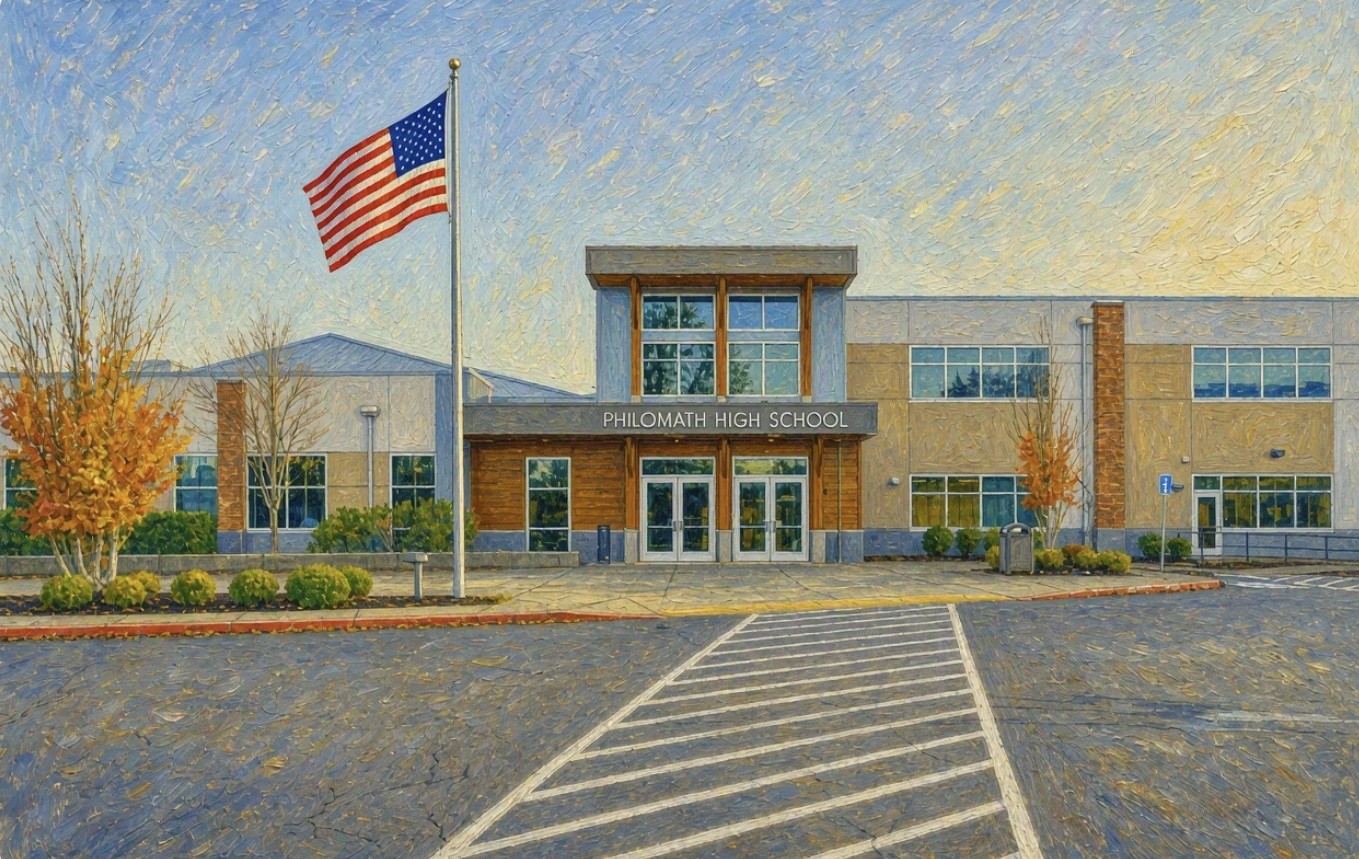
Philomath High School (PHS) sits just west of Corvallis and serves a small timber-country community. It nonetheless holds the strongest ranking in the region. U.S. News placed it 11th in Oregon after a 12th-place finish the previous year. The school’s 98% graduation rate ranks among the highest in the state.
The AP program is modest in participation but unusually accessible in practice. The Philomath School District covers the cost of AP exams, which removes a barrier many families face elsewhere. Furthermore, students can earn Linn-Benton Community College (LBCC) credit through College Now courses taught on campus. Juniors and seniors may also enroll directly at LBCC through the Beyond PHS program.
Signature Programs and Career Pathways
Philomath’s career and technical education programs reflect its setting. The Forestry/Natural Resources pathway, for instance, puts students on an on-campus sawmill and prepares them for regional forestry competitions. Meanwhile, the Health Occupations sequence offers LBCC credit, CPR certification, and work toward CNA licensure. Culinary and business students can likewise earn college credit and qualify for LBCC’s CTE Signing Day.
These pathways matter for admissions in a specific way. They give students documented, hands-on experience that connects naturally to majors in forestry, natural resources, or health sciences. Oregon State’s College of Forestry, for its part, sits only minutes away.
From a College Admissions Standpoint
Philomath offers the region’s most credentialed public school profile, along with a small senior class of roughly 116 students. That size gives strong students real visibility with counselors and teachers. In contrast, the 29% AP participation rate means advanced coursework is narrower than at larger schools. Students targeting highly selective colleges should therefore stack every available AP, add LBCC courses through Beyond PHS, and build one deep extracurricular commitment. A forestry or health pathway paired with Oregon State research exposure can create an unusually coherent, place-based application.
Crescent Valley High School
Public · North Corvallis, OR (Corvallis School District 509J)
| Metric | Data |
|---|---|
| U.S. News Oregon Rank | #18 |
| U.S. News National Rank | #1,955 |
| U.S. News STEM Rank | #420 nationally |
| U.S. News College Curriculum Breadth Index | #14 in Oregon |
| Enrollment (Grades 9–12) | ~930 |
| 12th Grade Enrollment | 246 |
| AP Participation Rate | 42% |
| Graduation Rate | 89% |
| School Counselors | 3 |
| Notable Programs | College Now (LBCC), Dual Language Immersion (Spanish), Health Occupations with hospital job shadowing |
Academic Model and AP Depth
Crescent Valley opened in 1971 on the rural northern edge of Corvallis. Today it is the higher-ranked of the city’s two district high schools. U.S. News places it 18th in Oregon and 420th nationally among STEM high schools. Moreover, its College Curriculum Breadth Index ranks 14th in the state, which signals a meaningful spread of AP exams.
The school’s catalog lists roughly a dozen AP courses on campus. These include AP Calculus BC, AP Chemistry, AP Environmental Science, AP US History, and AP Art. Several others, however, are taught only at Corvallis High, including AP Statistics, AP Psychology, AP Spanish, and both AP computer science courses. Notably, the school recommends no more than four AP courses per year, with administrative approval required beyond that limit.
College Credit, Programs, and Counseling
College Now is a genuine strength. Students can earn LBCC credit in courses such as AP US History, AP Government, AP Language, and Differential Calculus. Seniors may also take courses on LBCC’s campus through the Expanded Options Program. In addition, the Health Occupations course arranges job shadowing at Good Samaritan Hospital. A Field Ecology elective, meanwhile, suits students drawn to Oregon State’s environmental programs.
Counseling is lean. Three counselors serve the student body, supported by the Beyond CV college and career center. Accordingly, students who want individualized application strategy should plan to supplement in-house guidance.
From a College Admissions Standpoint
Crescent Valley gives motivated students a credible AP foundation in a mid-sized, academically engaged environment. Its strongest applicants pair core AP sciences and Calculus BC with something the school does not hand them: research, fieldwork, or sustained independent projects. Because some AP courses require a trip to Corvallis High, students should map four-year schedules early. That planning protects course rigor, which is the factor selective readers weigh most. Students should also ask counselors to note any cross-campus scheduling limits in the school report.

Corvallis High School
Public · Central Corvallis, OR (Corvallis School District 509J)
| Metric | Data |
|---|---|
| U.S. News Oregon Rank | #25 |
| U.S. News National Rank | #2,851 |
| U.S. News Corvallis Metro Rank | #3 |
| Enrollment (Grades 9–12) | ~1,273 |
| 12th Grade Enrollment | 349 |
| AP Participation Rate | 53% |
| Graduation Rate | 84% |
| U.S. News College Readiness Index | 47.6 |
| School Counselors | 4, plus a mental health therapist |
| Notable Programs | 4-year computer science sequence, manufacturing and vehicular design capstone, Dual Language Immersion, TRIO Upward Bound |
Academic Model and AP Breadth
Corvallis High School dates to 1910 and originally sat between downtown and the Oregon State campus. Its current building opened in 2005. With roughly 1,273 students, it is the region’s largest high school. Notably, its 53% AP participation rate is the highest among the area’s ranked schools. Its College Readiness score of 47.6 also leads the district.
In practice, Corvallis High functions as the district’s AP hub. The catalog lists more than 15 AP courses, including AP German, AP Physics C: Mechanics, AP Statistics, and AP Psychology. Furthermore, the computer science program runs four years, from introductory coding through AP Computer Science Principles, AP programming, and an advanced capstone. Honors American Literature can earn eight LBCC credits through College Now.
Career Pathways, Activities, and Support
The manufacturing pathway stands out. Students learn SolidWorks and MasterCAM, run CNC machines, and finish with a vehicular design capstone. In that capstone, teams design, build, and test a vehicle from the ground up. Additionally, the Advanced Digital Arts course operates an in-school design lab that serves real clients.
Clubs include Model UN, Speech and Debate, Robotics, and Science Club. Moreover, juniors attend the Benton County High School Career Convention at Oregon State. Eligible students can also join TRIO Upward Bound, which includes a summer residential program at OSU.
From a College Admissions Standpoint
Corvallis High offers the broadest AP catalog in the area, which gives ambitious students room to build a demanding transcript. That said, its lower state rank and 84% graduation rate mean readers will look closely at where each applicant sits within the school. Students aiming high should take the full AP sequence in their intended field and document projects beyond class requirements. A computer science or engineering applicant, for example, can point to the capstone sequence as evidence of sustained technical work. The four-counselor team serves a large student body, so outside strategic support often adds real value.
Charter Options in the Corvallis Area
Unlike larger metros, Corvallis has no IB Diploma school and no selective charter academy. Instead, its charter options are small rural K-12 schools with flexible models. Alsea Charter School, about 25 miles southwest, operates largely as a supplemental virtual program. Kings Valley Charter School, meanwhile, offers the more traditional in-person option profiled below.
| School | Grades | Total Enrollment | Grades 9–12 Enrollment | Model |
|---|---|---|---|---|
| Kings Valley Charter School | K–12 | ~193 | ~49 | Rural in-person charter |
| Alsea Charter School | K–12 | ~235 | 46 | Supplemental virtual charter |
Kings Valley Charter School
Public Charter · Kings Valley, OR (Philomath School District 17J)
| Metric | Data |
|---|---|
| Grades Served | K–12 |
| Total Enrollment | ~193 |
| Grades 9–12 Enrollment | ~49 |
| Student-Teacher Ratio | 14:1 |
| Median Core Class Size | 17 |
| Advanced Coursework | AP courses offered |
| Graduation Rate | 50% (small cohort) |
School Model and Strategic Fit
Northwest of Philomath, Kings Valley Charter School occupies a rural valley site. The original Kings Valley school dates to 1848. However, the Philomath district closed it in 2001, and it reopened a year later as a charter. It has since expanded to serve kindergarten through 12th grade. With roughly 49 high school students, it offers a level of personal attention no comprehensive school can match.
That intimacy comes with real limits. Its reported graduation rate reflects a very small cohort. Course options are also far narrower than at the district high schools.
From a College Admissions Standpoint
Kings Valley best serves families who prioritize a small, close-knit environment over academic breadth. A student targeting selective colleges from here must build rigor externally. In particular, LBCC courses and summer programs at Oregon State can fill gaps the school cannot. The counselor letter will matter enormously, so students should help their counselor describe exactly what the school offers.

Alsea Charter School
Public Charter · Alsea, OR (Alsea School District 7J)
| Metric | Data |
|---|---|
| Grades Served | K–12 (online OPTIONS program serves grades 6–12) |
| Total Enrollment | ~232 |
| Grades 9–12 Enrollment | 46 |
| Median Core Class Size | 14 |
| Four-Year Graduation Rate | 35% |
| Five-Year Completion Rate | 46% |
| College Credit | LBCC dual credit; Willamette Promise partnership |
| CTE Offerings | Welding, Ag Construction, Industrial Arts, Forestry, Plant and Animal Science, Culinary, Digital Design |
School Model and Programs
Alsea sits in the Coast Range foothills, about 25 miles southwest of Corvallis beyond Marys Peak. The district operates a single K-12 charter school, which also serves as the hub of a small timber community. Alongside the campus, the district runs Alsea OPTIONS, a self-paced online program for grades 6 through 12. According to the district, OPTIONS is open to Oregon residents statewide and offers both credit recovery and accelerated diploma tracks.
Hands-on career education is the campus’s clearest strength. Notably, a community-funded bond delivered a new vocational tech building in 2024, with a digital fabrication lab plus welding and woodshop equipment. Courses span welding, ag construction, forestry, and plant and animal science. Moreover, a Digital Design class connects graphic design to a school-based business. For college credit, the school works with Linn-Benton Community College and is partnering with Willamette Promise to add dual credit to high school courses.
Outcomes and Context
Oregon’s school profile reports a 35% four-year graduation rate and a 46% five-year completion rate. Both figures fall well below state averages. However, the school’s reported results likely combine campus students with online students, including those in credit recovery. As a result, the numbers say little about the experience of a motivated campus student.
The campus itself is very small. In fact, its median core class size of 14 is well below the statewide median of 23. Students can also compete in OSAA football, volleyball, basketball, track and field, baseball, and softball.
From a College Admissions Standpoint
Alsea best serves two groups: campus students who want a small rural school with hands-on trades, and students statewide who need a flexible online path. Selective colleges will know little about the school, and its published materials list no AP courses. Ambitious students should therefore build rigor through LBCC dual credit and document CTE projects with concrete outcomes. Forestry and plant science coursework, in particular, connects naturally to Oregon State programs in Corvallis. Online students should also ask counselors to explain the self-paced format in the school report.
Independent School Option: Santiam Christian Schools
Santiam Christian is the area’s primary private high school option.
Santiam Christian Schools
Private Christian · Adair Village, OR (6 miles north of Corvallis)
| Metric | Data |
|---|---|
| Grades Served | PK–12 |
| Total Enrollment | ~742 |
| High School Enrollment | ~234 |
| Founded | 1979 |
| Accreditation | ACSI and Cognia |
| NAIS Member | No |
| AP Courses | 6 (Calculus AB, English Language, U.S. Government, Statistics, Microeconomics, U.S. History) |
| Honors Courses | 6 |
| Dual Enrollment | 10 courses with LBCC; 1 with Corban University |
| AP Participation (Grades 11–12) | More than half of students take at least one AP course |
| Student-Teacher Ratio | 14:1 |
Academic Model and Programs
Santiam Christian occupies part of the former Camp Adair site, about six miles north of Corvallis. The school began in 1979 with 55 students and now serves preschool through 12th grade. It operates as a nondenominational nonprofit and requires a year of Bible study for each year of attendance.
Academically, the school pairs a traditional college-preparatory core with notable college-credit depth. It offers six AP courses and six honors courses. In addition, students can take 10 dual enrollment courses through LBCC, including College Algebra and English Composition. According to the school, more than half of juniors and seniors take at least one AP course.
Extracurriculars and Community
Santiam Christian supports full fine arts programming, including choir, band, and theater productions. Its campus also houses agriculture and culinary labs, greenhouses, and a woodshop. Furthermore, the school competes in Oregon’s small-school athletic classifications and has a long record of competitive teams.
From a College Admissions Standpoint
Santiam Christian suits families seeking a faith-integrated environment with genuine college-credit options. Its AP catalog is limited, however, so students targeting selective universities should pair available AP courses with LBCC dual enrollment. Because the school is not an NAIS member, selective readers outside Oregon may know it less well. As a result, a detailed school profile and a specific counselor letter carry extra weight. Service and leadership roles within the school community can also supply authentic essay material.

Other Notable Options in the Corvallis Area
Several additional pathways deserve mention for families evaluating the full landscape.
Philomath Academy is a small option school within the Philomath School District. Its catalog requires students to complete two transfer-level courses at LBCC. The academy also pays for eligible full-time students 16 and older to take LBCC courses. For a self-directed student, that structure can produce an early college transcript.
College Hill High School is the Corvallis district’s alternative high school, housed in the historic Harding School building. Its principal also coordinates the district’s Running Start partnership, which connects students with LBCC coursework.
Monroe High School is roughly 20 miles south in rural Benton County. Its small size creates close relationships with teachers, though advanced course options are limited.
How College Transitions Helps Corvallis-Area Families
College Transitions works with students from Philomath, Crescent Valley, Corvallis High, Santiam Christian, and other schools across Benton County. We help families with:
- Mapping four-year schedules that secure AP access across both district campuses, including courses taught at only one school
- Combining AP coursework with College Now, Running Start, and Expanded Options credit in ways that strengthen rather than dilute a transcript
- Turning proximity to Oregon State into documented research, fieldwork, or mentorship that selective readers can verify
- Building balanced college lists that weigh Oregon State, the Oregon Promise, and in-state options against national selective colleges
- Writing essays and activity descriptions that explain a small-market school context clearly to readers outside the Pacific Northwest
Final Thoughts
Philomath High School holds the region’s top U.S. News ranking and pairs a 98% graduation rate with district-funded AP exams. Its forestry and health pathways, moreover, give students distinctive, place-based experiences. Crescent Valley, meanwhile, offers a credible AP foundation, strong College Now options, and a top-15 statewide curriculum breadth ranking.
Corvallis High provides the area’s broadest AP catalog and highest AP participation rate. Its computer science and manufacturing sequences, in particular, reward students who commit early to a technical field. Kings Valley Charter, in contrast, serves families who value a very small community and can build rigor through outside coursework.
Santiam Christian, for its part, offers a faith-integrated option with meaningful AP and dual enrollment depth. Across every school, however, Oregon State’s presence remains the market’s greatest asset for students who use it intentionally. Wherever your student attends, College Transitions helps families in the Corvallis area turn strong academic options into clear, differentiated admissions plans.

