Oklahoma City’s High School Landscape
Oklahoma City sits at the center of a state built on energy and agriculture. Selective colleges rarely see this market in bulk, since Oklahoma sends a smaller pool of applicants to elite schools than similarly sized metro areas. Families researching Oklahoma City’s high schools quickly notice a split. A handful of small magnet and charter schools post AP participation near 80% while several larger zoned campuses report rates well below 30%. Independent schools, for their part, offer smaller classes and near-universal college placement, though at real tuition cost.
Prospective applicants in this market draw from four distinct categories:
- Selective public magnet and STEM charter schools with lottery or application admission
- Comprehensive suburban public schools serving large, zoned populations
- Independent day schools with competitive admission and small classes
- Traditional OKCPS zoned neighborhood schools, which vary widely in rigor
Families should understand how sharply admissions officers read the gap between a magnet transcript and a zoned-school transcript from the same city. What follows is a school-by-school look at how Oklahoma City’s top campuses compare.
How Oklahoma City Shapes the College Admissions Process
Selective admissions offices see comparatively few Oklahoma City applicants each cycle. A well-prepared applicant can stand out more easily here than in a saturated coastal suburb. That said, unfamiliarity cuts both ways. Officers may lean harder on test scores and course labels to calibrate an unfamiliar transcript.
In particular, Oklahoma’s flagship universities dominate in-state matriculation. The University of Oklahoma and Oklahoma State University enroll most Oklahoma City-area graduates. This happens largely because Oklahoma’s Promise scholarship covers full public-university tuition for income-eligible students. As a result, families targeting selective out-of-state admission often build a strategy that runs against this local pull rather than with it.
Beyond admissions-office familiarity, geography also plays a role. The metro spans several districts, including Oklahoma City Public Schools, Edmond, and Deer Creek. Each produces a different applicant profile. Consequently, a student’s zip code shapes both the rigor available and how officers read their transcript. Meanwhile, the energy and aerospace employers near Tinker Air Force Base give STEM-focused applicants a distinctive local narrative for essays.
In each case, internal competition stays relatively contained. Since only a few schools offer deep AP or IB access, students at Classen SAS, Harding, and Dove compete for many of the same honors. In contrast, Edmond and Deer Creek’s large suburban schools create a separate, size-driven competition for class rank.

Selective Magnet and Charter Schools
Oklahoma City’s strongest transcripts typically come from magnet and charter schools that enroll students from across the city. These schools post the highest AP rates in the state, with each reaching that rigor through a different structure.
| School | US News OK State Rank | US News National Rank | AP Participation | Graduation Rate | Enrollment (9-12) |
|---|---|---|---|---|---|
| Classen High School of Advanced Studies | #1 | #339 | 83% | 99% | 810 |
| Dove Science Academy High School | #2 | #282 | 81% | 97% | 389 |
| Harding Charter Preparatory High School | #4 | #425 | 85% | 98% | 573 |
| Santa Fe South Pathways Mid-College | #5 | #645 | 70% | 95% | 394 |
Classen High School of Advanced Studies
Public Magnet (IB) · Oklahoma City, OK
| Metric | Data |
|---|---|
| US News OK State Rank | #1 |
| US News National Rank | #339 |
| AP Participation | 83% |
| Graduation Rate | 99% |
| Enrollment (9-12) | 810 |
| Admission | Selective application, citywide draw |
Academic Model and Programs
Classen SAS is an application-based magnet inside Oklahoma City Public Schools. It draws students citywide rather than from one zoned neighborhood. The school pairs a full IB Diploma Programme with a broad AP slate. Consequently, students can choose the exam-heavy IB route or stack AP courses for flexibility. Notably, 83% of students take at least one AP exam. That rate outpaces every other OKCPS campus. Beyond the core curriculum, the school runs dedicated pathways in health sciences and pre-engineering.
Extracurriculars and College Counseling
Classen SAS fields a competitive DECA chapter and a nationally recognized debate program. The school also runs a research-driven science fair pipeline. Its counseling office manages a caseload built around a college-bound population, which is unusual for an OKCPS campus. As a result, counselors track IB and AP scores closely. They help students shape coursework into a coherent admissions narrative. Graduates matriculate heavily to Oklahoma’s flagships, though a meaningful share leaves the state each year.
From a College Admissions Standpoint
Classen SAS gives admissions officers the clearest signal available from an OKCPS campus. A transcript loaded with IB Higher Level courses demonstrates real rigor. Applicants should anchor essays in the IB Extended Essay or a research-heavy AP project, since both reflect the school’s academic identity. Given the citywide draw, students should also name their specific pathway, whether health sciences or pre-engineering, explicitly in the application.
Dove Science Academy High School
Public STEM Charter · Oklahoma City, OK
| Metric | Data |
|---|---|
| US News OK State Rank | #2 |
| US News National Rank | #282 |
| AP Participation | 81% |
| Graduation Rate | 97% |
| Enrollment (9-12) | 389 |
| Admission | Open-enrollment charter, lottery if oversubscribed |
Academic Model and Programs
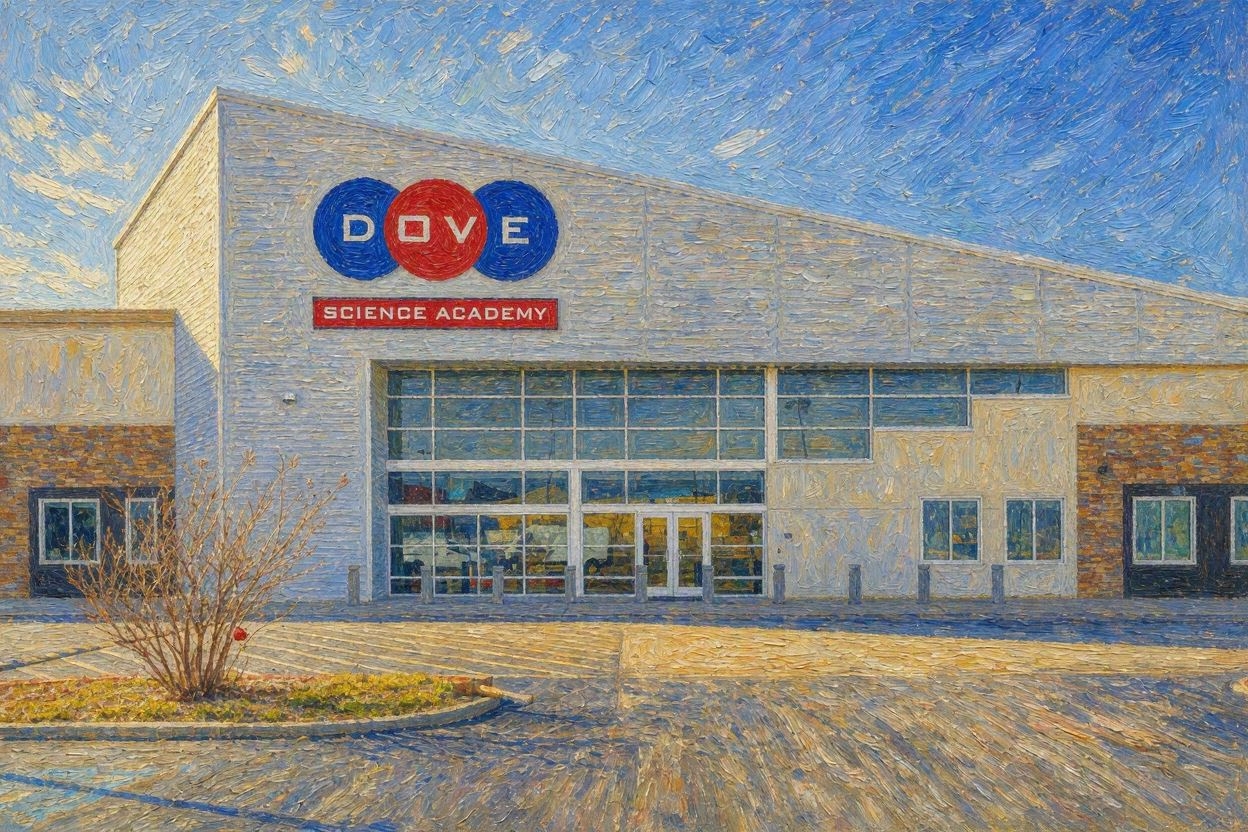
Dove Science Academy is a small, STEM-focused charter school. It operates independently of Oklahoma City Public Schools. Despite an enrollment under 400 students, the school posts the metro’s second-highest AP rate. The curriculum pushes math and science beyond state minimums. Furthermore, its Science Olympiad and robotics teams have advanced to national competitions in recent years. Because Dove is an open-enrollment charter, admission requires no entrance exam, though demand regularly exceeds seats.
Extracurriculars and College Counseling
In addition to STEM competitions, Dove runs a college-mentorship program pairing seniors directly with counselors. This close attention matters given the school’s size, since a single counselor can track nearly every senior’s application individually. Students frequently list Oklahoma’s flagship universities as top matriculation destinations, consistent with broader metro patterns.
From a College Admissions Standpoint
Dove’s chief strategic asset is STEM specificity. An applicant who leans into robotics or an independent research project builds a coherent transcript. Given the school’s modest size, officers may need extra context to calibrate an 81% AP rate. Applicants should therefore ask a counselor to detail the school’s grading scale directly in the counselor letter.
Harding Charter Preparatory High School
Public Charter · Oklahoma City, OK
| Metric | Data |
|---|---|
| US News OK State Rank | #4 |
| US News National Rank | #425 |
| AP Participation | 85% |
| Graduation Rate | 98% |
| Enrollment (9-12) | 573 |
| Admission | Open-enrollment charter, lottery if oversubscribed |
Academic Model and Programs
Harding Charter Preparatory built its identity around one expectation: every graduate should be ready for a four-year degree. The school runs a 4×4 plan, requiring four years each of math, science, English, and social studies. Since Harding admits by lottery, its 85% AP rate reflects broad-based rigor rather than a pre-selected pool. Moreover, roughly half the students are first-generation college applicants.
Extracurriculars and College Counseling
Harding folds college-application coursework directly into its schedule, with dedicated classes on essays and test prep. Additionally, the school fields active debate and mock trial programs. Meanwhile, counselors work with a caseload built entirely around a college-going population. This counseling model resembles what selective independent schools offer, delivered instead within a public charter structure.
From a College Admissions Standpoint
Harding’s open-lottery admission means officers should not assume a pre-selected applicant pool. Instead, an applicant’s individual course load carries more weight in signaling readiness. Students should highlight the school’s structured college-prep coursework, since it demonstrates institutional support. Given the sizable first-generation population, essays that speak candidly to a family’s college-going history can add useful context.
Santa Fe South Pathways Mid-College
Public Charter · Oklahoma City, OK
| Metric | Data |
|---|---|
| US News OK State Rank | #5 |
| US News National Rank | #645 |
| AP Participation | 70% |
| Graduation Rate | 95% |
| Enrollment (9-12) | 394 |
| Admission | Open-enrollment charter within the Santa Fe South system |
Academic Model and Programs
Santa Fe South Pathways Mid-College pairs a standard curriculum with early access to college coursework. Its mid-college structure lets students take college classes alongside high school requirements. As a result, many graduate with a semester or more of transferable credit. The school serves many first-generation and Spanish-speaking families, and its programming reflects that reality. Notably, its 70% AP rate sits alongside an even heavier concurrent-enrollment load.
Extracurriculars and College Counseling
The counseling office coordinates closely with the school’s concurrent-enrollment partner. It tracks college credit alongside traditional metrics. Extracurricular offerings run smaller than at larger campuses. That said, groups focused on college access and first-generation support play an outsized role each spring.
From a College Admissions Standpoint
An applicant here should center concurrent-enrollment grades as the strongest evidence of readiness, since they reflect an actual college classroom. Given the smaller AP slate relative to Classen or Harding, students should ask their counselor to explain the mid-college credit structure directly in the school profile. First-generation applicants can tie the school’s mission to their own trajectory in essays.

Comprehensive Suburban Public Schools
Beyond the magnet and charter tier, Oklahoma City’s large suburban districts offer scale rather than selectivity. These schools serve thousands of students and offer wide course catalogs. Participation in advanced coursework naturally trails the smaller, focused schools above.
| School | US News OK State Rank | US News National Rank | AP Participation | Graduation Rate | Enrollment (9-12) |
|---|---|---|---|---|---|
| Edmond Memorial High School | #6 | #833 | 47% | 89% | 2,770 |
| Deer Creek High School | #11 | #1,374 | 40% | 96% | 2,290 |
Edmond Memorial High School
Public · Edmond, OK
| Metric | Data |
|---|---|
| US News OK State Rank | #6 |
| US News National Rank | #833 |
| AP Participation | 47% |
| Graduation Rate | 89% |
| Enrollment (9-12) | 2,770 |
| Notable Program | Extensive AP catalog, Francis Tuttle Technology Center partnership |
Academic Model and Programs
Edmond Memorial is the oldest of Edmond’s three comprehensive high schools. It serves a large, zoned population north of Oklahoma City. The school offers a wide AP catalog spanning the sciences, humanities, and world languages. Its 47% participation rate, however, reflects a broader mix of student goals than a smaller magnet campus. Notably, the school’s size, nearly 2,770 students, funds specialized electives a smaller school could not sustain. Additionally, Memorial maintains strong ties to Francis Tuttle Technology Center.
Extracurriculars and College Counseling
Memorial fields a full slate of athletics, fine arts, and academic competition teams. Meanwhile, the counseling office manages a substantial caseload. Students seeking individualized admissions strategy should plan to be proactive about scheduling meetings. That said, the school’s size also produces a wide range of outcomes.
From a College Admissions Standpoint
At a school this large, course rigor relative to Memorial’s own catalog matters more than a raw AP count. Applicants should max out the most rigorous track available to them. Given the graduating class size, students should also lean on personal extracurricular depth, since broad activity lists can otherwise blur together for a reader.
Deer Creek High School
Public · Edmond, OK
| Metric | Data |
|---|---|
| US News OK State Rank | #11 |
| US News National Rank | #1,374 |
| AP Participation | 40% |
| Graduation Rate | 96% |
| Enrollment (9-12) | 2,290 |
| Notable Program | Concurrent enrollment, Francis Tuttle Technology Center partnership |
Academic Model and Programs
Deer Creek High School serves a fast-growing suburban district on Oklahoma City’s northwest edge. Its enrollment has expanded rapidly over the past decade. The school pairs AP coursework with concurrent enrollment through nearby colleges. A Francis Tuttle Technology Center partnership adds career-technical credentials alongside the diploma track. Because the district has grown so quickly, course offerings have expanded accordingly, though the 40% AP rate still trails the metro’s magnet options.
Extracurriculars and College Counseling
Deer Creek fields competitive athletics and fine arts programs that draw strong community support. Counselors here work with a large and growing caseload. Families should expect to take an active role in scheduling meetings well before senior year. Graduates matriculate heavily to Oklahoma’s flagships.
From a College Admissions Standpoint
Deer Creek’s rapid growth means its academic profile is still evolving. Applicants should make sure their counselor’s letter reflects the school’s current course catalog. Students should also treat concurrent-enrollment grades as equally important to AP scores, since both signal readiness. Given the school’s size, standing out depends on depth in one or two interests.
Where OKCPS Zoned Neighborhood Schools Stand
Families should also understand where OKCPS’s traditional zoned campuses fall in this picture. Northwest Classen, Southeast, Capitol Hill, Douglass, and John Marshall currently rank in the state’s bottom quartile. Their AP rates often sit below 30%. This gap does not reflect the effort of individual students. Rather, it reflects a citywide divide between OKCPS’s magnet programs and its zoned campuses. Consequently, a strong student at a zoned school can still build a competitive application, though the strategy looks different. Leaning on outside enrichment and concurrent enrollment through Oklahoma City Community College becomes more important when the school profile offers less built-in rigor.

Independent Schools
Oklahoma City’s independent day schools offer a smaller, more closely supported alternative. Each maintains a low student-teacher ratio and reports strong college matriculation. That said, families should weigh real tuition costs against that added support.
| School | Type | Enrollment | Student-Teacher Ratio | Association |
|---|---|---|---|---|
| Casady School | Episcopal, coed, PK-12 | 1,000 | 8:1 | NAIS |
| Heritage Hall | Nonsectarian, coed, PK-12 | 890 | 9:1 | NAIS |
| Bishop McGuinness Catholic HS | Catholic, coed, 9-12 | 720 | 11:1 | NCEA |
Casady School
Private (Episcopal) · Oklahoma City, OK
| Metric | Data |
|---|---|
| Type | Independent, Episcopal, PK-12 |
| Enrollment | 1,000 |
| Student-Teacher Ratio | 8:1 |
| Association | NAIS |
| Average ACT | 30 |
Academic Model and Programs
Casady School is Oklahoma City’s oldest independent, college-preparatory school. It was founded in 1947 by the Episcopal Diocese of Oklahoma. The school runs prekindergarten through twelfth grade with an 8-to-1 ratio, allowing close faculty attention in the upper school. Casady’s program includes a substantial AP and honors catalog, alongside an interdisciplinary approach across departments. Additionally, its average reported ACT of 30 places graduates well above state and national averages.
Extracurriculars and College Counseling
Casady maintains competitive athletics, debate, and fine arts programs. The school’s small size lets most students take on multiple activities rather than specializing narrowly. Meanwhile, the counseling office publishes detailed matriculation data each year. Historically, Casady has sent graduates to selective national universities alongside strong in-state flagship enrollment, though it does not publish a HYPSM figure.
From a College Admissions Standpoint
Casady’s core admissions advantage is documented rigor. An 8-to-1 ratio and a strong AP catalog give officers a clear academic profile. Applicants should lean on Casady’s interdisciplinary structure when framing intellectual interests in essays. Given the school’s long track record, students should also ask which colleges show strong familiarity with Casady’s transcript.
Heritage Hall
Private (Nonsectarian) · Oklahoma City, OK
| Metric | Data |
|---|---|
| Type | Independent, nonsectarian, PK-12 |
| Enrollment | 890 |
| Student-Teacher Ratio | 9:1 |
| Association | NAIS |
| Matriculation to Four-Year Colleges | 99% |
Academic Model and Programs
Heritage Hall opened in 1969 as a nonsectarian alternative during a period of citywide busing changes. Today, the school runs preschool through twelfth grade with a 9-to-1 ratio. Upper-school class sizes rarely exceed the low twenties. The program emphasizes small, discussion-based classes, and the school holds a Cum Laude Society chapter. Admission requires an entrance exam, teacher recommendations, and a campus visit.
Extracurriculars and College Counseling
Heritage Hall reports a 100% college acceptance rate and a 99% four-year matriculation rate. The school attributes both figures to close counseling relationships. Notably, more than half of graduates typically enroll out of state. That pattern reflects a counseling approach that pushes students beyond Oklahoma’s flagships.
From a College Admissions Standpoint
Heritage Hall’s small classes and Cum Laude chapter give officers an unusually clear read on class rank. Students should ask teachers for detailed, specific recommendation letters rather than general praise. Given that more than half the class leaves Oklahoma, applicants targeting out-of-state schools can point to this as evidence of counseling support.
Bishop McGuinness Catholic High School
Private (Catholic) · Oklahoma City, OK
| Metric | Data |
|---|---|
| Type | Independent, Catholic, 9-12 |
| Enrollment | 720 |
| Student-Teacher Ratio | 11:1 |
| Association | NCEA |
| AP Courses Offered | 21 |
Academic Model and Programs
Bishop McGuinness has operated as part of the Archdiocese of Oklahoma City since 1950. The school offers a college-preparatory curriculum built around Catholic values. It runs 21 AP courses and 12 pre-AP courses across more than 130 total offerings. With an 11-to-1 ratio, the school sits between the city’s smaller independent schools and its larger public campuses in scale. Furthermore, the school folds religious formation directly into daily academic life.
Extracurriculars and College Counseling
Bishop McGuinness fields fifteen interscholastic sports alongside strong fine arts and service programs. More than 98% of graduates enroll in two- or four-year colleges. The school attributes that figure to individualized planning paired with its 11-to-1 ratio. Counselors work closely with students on both admissions and scholarship strategy.
From a College Admissions Standpoint
An applicant here should use the 21-course AP catalog to show sustained rigor across subject areas. Since the school’s Catholic identity runs through its programming, students in service leadership or campus ministry can use those experiences to add depth. That said, the essay should connect to a broader personal narrative rather than describe the program alone.

How College Transitions Helps Oklahoma City-Area Families
- Building an application strategy that accounts for the metro’s split between magnet, charter, comprehensive, and independent options
- Identifying which selective colleges have historical familiarity with a specific Oklahoma City-area school’s transcript
- Helping students at OKCPS zoned schools build competitive applications despite more limited AP or IB access
- Guiding families through Oklahoma’s Promise scholarship requirements alongside out-of-state financial aid planning
- Developing supplemental essay strategy that connects a student’s specific school pathway to their broader academic story
Final Thoughts
Oklahoma City’s selective magnet and charter schools offer the clearest path to a rigorous transcript. Classen SAS pairs IB and AP coursework inside a citywide public option. Meanwhile, Dove Science Academy and Harding Charter Preparatory prove that a small, focused charter school can rival any private school on AP participation. Santa Fe South Pathways Mid-College adds a distinct concurrent-enrollment model. Each of these schools rewards students willing to seek them out rather than default to a zoned assignment.
Edmond Memorial and Deer Creek represent the metro’s large comprehensive option, where scale brings both resources and a wider range of outcomes. Families here should treat course selection and extracurricular depth as the primary differentiators, since a big graduating class means officers cannot rely on school reputation alone. OKCPS’s zoned neighborhood schools require a more resourceful strategy, built around outside enrichment and a clearly documented personal narrative.
Casady School, Heritage Hall, and Bishop McGuinness give families a smaller, more closely supported alternative. Each reports strong four-year matriculation rates and low student-teacher ratios. These schools suit students who want individualized counseling and a transcript that reads clearly to selective offices nationwide. Wherever your student attends, College Transitions helps families in the Oklahoma City area turn strong academic options into clear, differentiated admissions plans.