
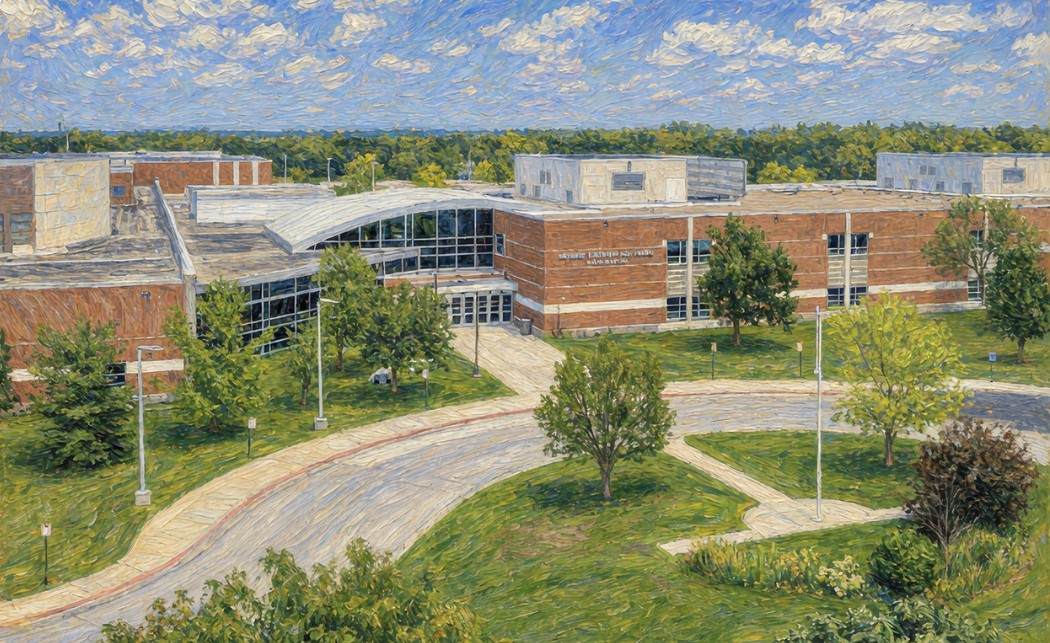
Lawrence, Kansas, is not a place most people associate with cutthroat college admissions. However, families in this university town know the picture is more complicated. Students at Lawrence Free State High School and Lawrence High School grow up a few miles from the University of Kansas, and many have parents who teach, research, or work there. Consequently, a large share of local applicants arrive with similar academic profiles and similar KU-connected activities. Meanwhile, nearby Baldwin High School and Eudora High School send students into the same applicant pools. Students from Johnson County’s suburban schools, less than an hour east, add even more competition for the same spots at selective colleges. For a Lawrence student aiming beyond the region, the real question is not whether to take hard classes. Instead, it is how to stand out among peers who are taking the same ones.
Meet Audrey: A Curious Student Who Needed a Focus
Audrey attended Lawrence Free State High School, which U.S. News ranks 19th in Kansas and 3,097th nationally in its most recent list. The school ranks 10th in the state for college readiness, and 40% of students take at least one AP exam. Free State offers nearly 20 AP courses, along with discounted KU Blueprint college courses and dual credit options. Notably, the school takes its name from Lawrence’s role in Kansas entering the Union as a free state.
By sophomore year, Audrey had a 3.9 unweighted GPA and a long list of loosely connected interests. Specifically, she volunteered at a nature center, took photographs of wildflowers, and helped in a biology classroom. Her family began working with College Transitions that spring. Above all, her counselor wanted to find the thread that tied her interests together.

1. Choosing a Strategic Major: Entomology
During her first meetings with College Transitions, Audrey kept returning to one memory. In seventh grade, she had tagged a monarch butterfly at the Baker Wetlands Discovery Center during Monarch Watch’s annual fall event. Furthermore, she still checked the tag recovery database every winter to see whether her butterfly had reached Mexico. Her counselor pointed out that this was not a passing hobby; it was a research interest that she had been quietly building for years.
Entomology offered a precise, uncommon direction. Additionally, Lawrence gave her unusual access to the field. Monarch Watch, founded at KU in 1992 by Chip Taylor, operates from KU’s West Campus and has distributed millions of migration tags across North America. KU’s Biodiversity Institute also holds an entomology collection of roughly 4.9 million pinned specimens, which Francis Huntington Snow started in 1870.
Why Entomology Made Sense
- Few applicants nationwide choose entomology, so her application would not blend into a crowded biology pool
- Monarch Watch and KU’s entomology collection gave her local resources that almost no other applicant could claim
- The major connected her photography, nature center work, and science coursework into one profile
- Programs at Cornell, Purdue, and Michigan State offer dedicated undergraduate entomology degrees
2. Improving Her ACT Score: From 26 to 33
Kansas pays for every public high school junior to take the ACT during the school day. Therefore, Audrey planned her testing around that free spring administration. Her first official score, from a national test date in the fall of junior year, was a 26. Science and math were her strongest sections, while reading pacing pulled her composite down.
College Transitions built a 12-week plan with her that focused on timed reading passages and error tracking. Subsequently, she practiced with official ACT materials three times a week and reviewed every missed question in a running log. Her reading score rose by six points. Consequently, she earned a 33 composite on the test in the spring. That score placed her within or above the middle 50% range at each school on her list.
3. Deepening Her Extracurriculars: From Volunteer to Founder
Audrey’s activities had been scattered across several organizations. However, her counselor encouraged her to build one sustained project instead of adding more clubs. As a junior, she founded the Free State Pollinator Club and led its effort to register a certified Monarch Waystation on school grounds. Monarch Watch runs the Waystation program and maintains Waystation No. 1 at its home on KU’s campus.
What Audrey Did Differently
- She recruited 22 members and secured approval from school administrators to convert an unused courtyard into native habitat
- She organized club volunteers for Monarch Watch’s spring open house and plant fundraiser
- Her club trained younger students to net and tag butterflies at the fall tagging event at Baker Wetlands
- She photographed every life stage in the garden and built a field guide for Free State science classes
Ultimately, these activities showed admissions readers leadership, initiative, and real commitment to her major.
4. Adding Research: Milkweed, Larvae, and a Highway
Research was the step that set Audrey apart. With guidance from College Transitions, she wrote to a KU ecology graduate student whose work involved pollinator habitat. She proposed a project she could run with her own data rather than asking for a general lab position. The graduate student agreed to review her methods and meet with her once a month.
Her project examined monarch egg and larva counts on milkweed at three sites around south Lawrence. Two sites sat near the South Lawrence Trafficway, which runs along the edge of the Baker Wetlands. The third was her school’s new waystation. Over two summers, she logged weekly counts and compared them with roadside traffic data.
Project Scope
- Weekly surveys of 120 tagged milkweed stems across three sites
- Comparison of larval survival rates near and away from heavy traffic
- Analysis of local tag recovery data from past Monarch Watch events
- A final paper and poster on how roadside habitat affects early larval survival
5. Entering Competitions for External Validation
Strong research needs an outside audience. Accordingly, Audrey entered her project in the Greater Kansas City Science and Engineering Fair, a Regeneron ISEF-affiliated competition held each spring at Union Station. Students from Kansas and Missouri high schools compete there across categories that include animal science and earth and environmental science.
She placed second in the senior animal science division during her junior year. Furthermore, the judges’ feedback helped her strengthen her statistical analysis before she expanded the study the next summer. As a senior, she presented an updated version that included a second year of larval counts. Above all, these results gave admissions readers independent proof that her research held up to expert review.
College Transitions also helped her describe the project clearly in her activities list. Specifically, her counselor showed her how to explain methods and results within the Common App’s 150-character limit.
6. Writing a Personal Statement Rooted in Place
Audrey’s first essay draft explained why insects matter to the planet. Her counselor noted that the draft could have come from any applicant in any state. Instead, they searched for a moment only Audrey could describe.
She landed on a September morning at the Baker Wetlands. While tagging monarchs with a group of younger students, she watched a butterfly drift toward the traffic on the trafficway and then lift over it. That moment led her to the question that drove her research: how much does a single road shape the life of an insect weighing less than a gram?
The final essay moved from that scene to her nights entering larval counts into a spreadsheet. Additionally, it showed how a childhood hobby had become a scientific question. Her Cornell supplement built on the same theme. In it, she explained how she hoped to study insect movement and habitat loss within a department that calls itself home to the nation’s first entomology program.

7. Using Early Action and Early Decision Strategically
College Transitions helped Audrey build a list of colleges with dedicated entomology majors and strong research access for undergraduates. Rather than spreading applications widely, she focused on schools where her major and her monarch research fit naturally. Each application told the same story, so her essays and activities reinforced one another across every school.
Early Action Schools
- Purdue University (Insect Biology): Accepted
- Michigan State University (Entomology): Accepted
Early Decision School
- Cornell University, College of Agriculture and Life Sciences (Entomology): Accepted
Cornell was her clear first choice. Therefore, applying Early Decision made sense once her family confirmed the commitment worked for them. Meanwhile, her two Early Action applications gave her strong options in programs that matched the same interests.
Why Audrey’s Strategy Worked
- She chose a specific, uncommon major that tied her interests together
- She raised her ACT score from 26 to 33 using a targeted, data-driven plan
- She turned scattered volunteering into a founded club and a certified Monarch Waystation
- She designed original research using habitat and traffic patterns only Lawrence could offer
- She earned outside recognition at an ISEF-affiliated science fair
- She wrote a personal statement built around a single, vivid local moment
- She used EA and ED to apply only where her major and research fit
Simply put, every part of her application pointed in the same direction.
What This Means for Lawrence Families
Students at Lawrence High School, Baldwin High School, Eudora High School, and Free State all share Audrey’s local advantage. Lawrence offers a major research university, a world-class insect collection, a 927-acre wetland, and programs like Monarch Watch within a short drive. However, these resources only help students who use them deliberately. Selective colleges expect applicants to show:
- Rigorous coursework, including AP or KU Blueprint classes in their area of interest
- Depth in one or two activities rather than a long list of memberships
- Independent work, such as research or a sustained project with measurable results
- Essays and supplements that reveal a specific, personal connection to their chosen field
For Lawrence students, the goal is to turn familiar local places into evidence of real intellectual commitment. College Transitions helps families build that kind of focused strategy, from choosing a major to finalizing an Early Decision list.

