
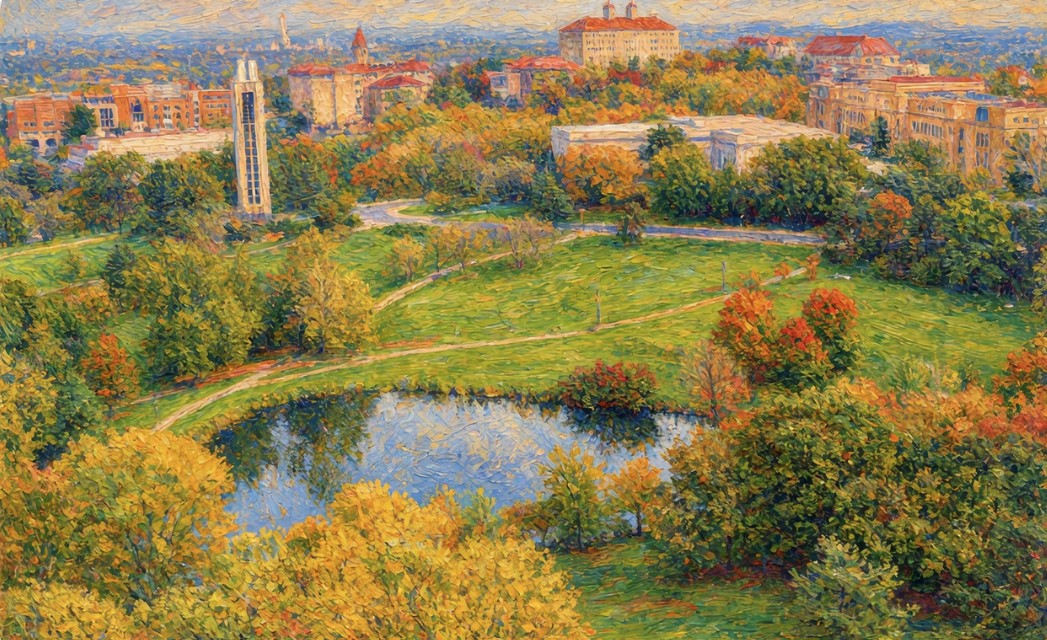
Few Kansas towns are as shaped by a university as Lawrence. The University of Kansas sits on Mount Oread above Massachusetts Street, and Haskell Indian Nations University anchors the south side of town. In fact, campus life sets the rhythm of the whole city, from basketball season to summer camps. For a college-bound teenager, that sounds like an obvious advantage.
So, is Lawrence a good place for college admissions? In many ways, yes. Students here can earn KU credit without leaving their high school, and research labs sit a short drive from home. At the same time, the town’s closeness to KU creates its own trap. Specifically, KU’s assured admission policy makes it easy for strong students to stop reaching. This guide looks at both sides and explains how Lawrence families can use the town’s strengths without settling for less.

Lawrence’s High School Landscape at a Glance
Public Schools
Most Lawrence students attend one of two large district high schools. Lawrence Free State High School opened in 1997 in northwest Lawrence, and it now enrolls about 1,774 students. Meanwhile, Lawrence High School has occupied its Louisiana Street campus since 1954. Its student newspaper, The Budget, has published for more than a century.
Both schools run the same college-credit options through KU. However, their profiles differ. Free State posts the higher state rank and a 40% AP participation rate. Lawrence High, by contrast, ranks lower overall but offers about 17 AP courses. Nearby, smaller districts in Baldwin City and Eudora give families a more intimate public option.
Independent, Virtual, and Career Options
Lawrence also supports two independent schools. Bishop Seabury Academy serves grades 6 through 12 with very small classes. Veritas Christian School, in turn, offers a classical, faith-based program from kindergarten through 12th grade.
Beyond those, Lawrence Virtual School is one of the few state-approved charter schools in Kansas. The district also runs the Lawrence College and Career Center, which connects students to technical training. Notably, the district announced plans to redesign that center’s partnership with Peaslee Tech. Together, these choices give Lawrence more variety than its size suggests.
How Lawrence-Area High Schools Compare
Lawrence’s own U.S. News metro list includes only a handful of ranked schools. For that reason, the table below widens the lens to nearby districts within roughly 35 miles. These schools include De Soto and Shawnee in Johnson County, Basehor and Tonganoxie to the northeast, and Washburn Rural in southwest Topeka.
| School | US News Kansas Rank | US News National Rank | AP Rate |
|---|---|---|---|
| DeSoto High School (De Soto) | #9 | #2,000 | 37% |
| Mill Valley High School (Shawnee) | #12 | #2,400 | 31% |
| Lawrence Free State High School (Lawrence) | #19 | #3,097 | 40% |
| Washburn Rural High School (Topeka) | #32 | #4,405 | 30% |
| Lawrence High School (Lawrence) | #42 | #5,744 | 31% |
| Baldwin High School (Baldwin City) | #50 | #6,262 | 16% |
| Basehor-Linwood High School (Basehor) | #51 | #6,297 | — |
| Tonganoxie High School (Tonganoxie) | #125 | #10,231 | 20% |
| Eudora High School (Eudora) | #172 | #12,469 | — |
| Lawrence Virtual School (Lawrence) | #193-295 | #13,460-17,945 | — |
Free State is the strongest school inside the city limits. Still, two De Soto district schools rank higher statewide. As a result, Lawrence families sometimes compare their options with Johnson County suburbs. That comparison matters less than it seems, though. Admissions readers judge each student within the context of the school they attend.

Where Lawrence Gives Students an Edge
KU Credit Without Leaving High School
Lawrence’s clearest advantage is the Jayhawk Blueprint. Through this partnership, juniors and seniors at Free State and Lawrence High take KU courses inside their own school buildings. Approved high school teachers teach the courses, while KU faculty liaisons oversee the curriculum. Students can earn up to 22 hours of transferable college credit before graduation.
The program is also affordable. In 2025-26, Blueprint courses cost one-third of KU’s undergraduate in-state tuition rate. Moreover, KU provides textbooks free of charge. Students who qualify for free or reduced meals can also receive full or partial tuition waivers through the Lawrence Schools Foundation. In fact, the district made stronger Blueprint offerings a stated priority for the 2025-26 school year.
KU Labs and Summer Programs
Living next to a research university opens doors that most Kansas students cannot easily reach. For example, the Chemical Engineering Experience in Research (ChEER) program places high schoolers in KU labs. It is open to students ages 15 to 18 who have not yet graduated. Interns work four hours a day for about four weeks each summer, and applications open in the spring. Because the internship is unpaid and offers no housing, it suits local students best.
KU runs several other summer programs as well. The School of Engineering hosts two weeklong residential camps each July, one for rising 9th and 10th graders and one for rising 11th and 12th graders. Every camper lives in a residence hall, even local students. Similarly, KU Design Camp introduces rising sophomores, juniors, and seniors to architecture and design. Participants build work that can strengthen a creative portfolio.
Arts and Community Roles
Lawrence’s arts scene gives creative students a real outlet. The Lawrence Arts Center offers teen classes in ceramics, darkroom photography, and graphic novels. Its Teen Artist Co-Op lets students ages 13 to 16 work in professional studios. Moreover, co-op artists can display their work at the center and keep the proceeds of any sales. Financial aid is available for families who need it.
Students interested in health care or public service can also look to LMH Health, Lawrence’s community hospital. Its Summer Leadership Academy is a paid, eight-week mentorship program for high school juniors and seniors. LMH Health runs it with the City of Lawrence, so students explore careers in both health care and city government. Applicants must attend a Lawrence-area high school and turn 16 by June 1 of the program year.
The Honest Challenges of Applying From Lawrence
The KU Default
KU’s assured admission policy is generous. Under current standards, a 3.25 high school GPA guarantees admission. In addition, students below that mark can qualify with a 21 ACT and a 2.0 GPA. For many families, that certainty is a gift.
Ambitious students, however, can find it becomes a ceiling. When the hometown flagship is guaranteed, the urgency to aim higher fades. Some strong Lawrence students never seriously research selective colleges elsewhere. Others apply late, with essays written in a rush. Consequently, the town’s biggest asset can quietly narrow a student’s options.
Grade Compression and Thin Counseling
Free State’s senior classes include hundreds of college-bound students, many with academic parents. One year, the school recognized 36 valedictorians in a single year. Top grades alone rarely set one applicant apart in that environment.
Counseling support is also stretched. Recent federal data shows Free State with four full-time counselors, or more than 400 students each. As a result, families should not expect frequent one-on-one college planning at school.
Limited Recognition Beyond the Region
Admissions offices at Big 12 and Big Ten universities see Lawrence applicants every year. Selective private colleges on the coasts, on the other hand, see far fewer. Readers at those schools may not know what a Free State transcript represents. Therefore, Lawrence students often need their materials to explain the context of their coursework.
No IB and Modest AP Depth
No Lawrence-area high school offers the International Baccalaureate Diploma. The nearest IB World School is Washburn Rural in Topeka. Meanwhile, AP participation at Lawrence’s two high schools sits between 31% and 40%. That rate is solid for Kansas, yet well below the most competitive suburban schools nationwide. Students who want a top-tier course load must build it deliberately.

A Strategy for Lawrence Applicants
Build Rigor With AP and Blueprint
Selective colleges expect students to take the most demanding courses available to them. In Lawrence, that usually means a strong AP sequence combined with Jayhawk Blueprint. Students should choose Blueprint courses that connect to their intended field. Similarly, they should avoid dropping core subjects senior year. A transcript that stays challenging through 12th grade sends a clear signal.
Treat the State ACT as a Starting Point
Kansas pays for every public school junior to take the ACT. That free test is a useful baseline. However, students aiming at selective colleges should plan to test again after targeted preparation. KU’s test-optional policy does not reflect every college on a national list. In fact, several highly selective schools now require scores again. A strong score can also help out-of-state readers calibrate an unfamiliar curriculum.
Write Essays Only a Lawrence Student Could Write
The college essay is where context comes alive. Generic essays about hard work or leadership blend together quickly. Instead, students should look for moments rooted in their own experience of the town. A summer in a KU lab, a shift at the library, or a piece shown at the Arts Center can anchor a story. The goal is a specific, personal account that no other applicant could tell.
Plan Early Decision With Care
Early Decision can offer a real boost at many selective colleges. Still, it is a binding commitment. Families should confirm their first choice and review financial aid estimates before applying. In addition, students should finish testing and a polished essay by early fall of senior year. That timeline requires work over the summer before 12th grade.
Build a National College List
A balanced list includes reach, target, and likely schools across several regions. KU can remain a strong, affordable likely option. Nevertheless, Lawrence students should research colleges outside Kansas, including small liberal arts colleges and selective universities. Visiting campuses during trips to Kansas City or Chicago can make distant options feel real.
Start Early
The best Lawrence applicants begin planning in 9th or 10th grade. Early planning gives students time to map an AP and Blueprint sequence. It also leaves room to pursue summer programs, which often require applications months ahead. Ultimately, starting early turns local opportunity into a sustained record of achievement.
The Takeaway: Is Lawrence a Good Place for College Admissions?
Lawrence offers resources that few Kansas towns can match. Students can earn KU credit in their own classrooms, work in university labs, and study in professional arts studios. In addition, the cost of that access is unusually low. For motivated students, Lawrence is an excellent place to build a strong application.
The challenges are real, though. KU’s guaranteed admission can lower expectations, and counselors are stretched thin. Furthermore, selective colleges outside the region may need help understanding a Lawrence transcript. Students who succeed here use local resources with intention and aim beyond the obvious choice.
College Transitions works with families across the Lawrence area, including students at Lawrence Free State High School, Lawrence High School, Bishop Seabury Academy, Veritas Christian School, Lawrence Virtual School, and nearby schools in Baldwin City, Eudora, and De Soto. Our counselors help students choose the right AP and Jayhawk Blueprint courses, plan testing, and build balanced national college lists. We also guide students through essays and Early Decision strategy. In a town where KU is always close at hand, we help Lawrence students see how far their options can reach.

