
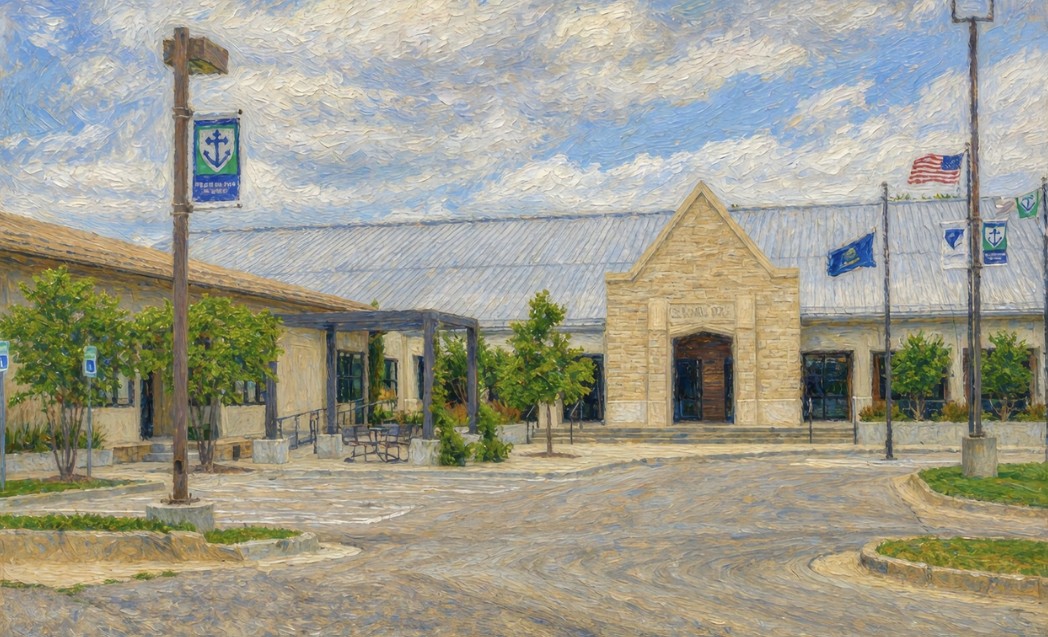
Lawrence is a college town in the fullest sense. The University of Kansas sits on Mount Oread above downtown, while Haskell Indian Nations University anchors the south side of the city. As a result, higher education shapes daily life here more than in almost any other Kansas community. That said, growing up near a major university does not guarantee a strong application to a selective college elsewhere.
Families in the Lawrence area can choose among two large district high schools, a smaller public school in Baldwin City, and a statewide virtual charter. In addition, the district runs a career center, and the city supports two independent schools. Students in the district’s public options can also earn KU credit without leaving their high school building. For that reason, a useful comparison has to go beyond rankings alone.
From a college admissions standpoint, Lawrence-area schools differ meaningfully in:
- Depth of AP coursework and access to KU concurrent enrollment
- Size of the graduating class and the competition for top grades
- Counselor caseloads and the amount of individual guidance available
- Recognition among admissions offices outside Kansas
- How clearly each transcript signals rigor to an out-of-state reader
The school-by-school analysis below begins with the public high schools that educate most Lawrence students.

The Lawrence-Area College Admissions Landscape: What Families Need to Know
How Admissions Offices View Lawrence
Admissions offices across the Midwest know Lawrence well. In particular, readers at Big Ten and Big 12 universities see files from Free State and Lawrence High every year. Selective private colleges on the coasts see far fewer applications from Douglas County. Consequently, an applicant’s materials often need to explain the strengths of a Lawrence school.
Free State holds the stronger statistical profile. Specifically, U.S. News ranks it 10th in Kansas on its most recent College Readiness Index. Lawrence High follows at 23rd on the same measure. Both figures place the district well above most Kansas peers. Nevertheless, neither school sits at the top of a statewide list long led by Johnson County schools.
The KU Advantage
KU’s presence shapes nearly every academic option in town. Through Jayhawk Blueprint, juniors and seniors in Lawrence Public Schools take KU courses inside their own high school. Moreover, these courses cost one-third of KU’s in-state undergraduate rate, and textbooks are free. Students can currently earn up to 22 KU credit hours this way. Need-based tuition waivers also help families who qualify for free or reduced-price meals.
Proximity creates research and enrichment opportunities that most Kansas students cannot easily reach. In turn, that access raises expectations. A selective college reading a Lawrence file may fairly ask what the student did with a major research university nearby.
State Policy and the Flagship Pull
Kansas policy makes KU an easy default. KU grants assured admission to first-year applicants with a 3.25 cumulative GPA. Alternatively, students qualify with a 2.0 GPA plus a 21 ACT or 1060 SAT. KU is also test optional. As a result, many strong students treat KU as a sure thing and apply to only a few reach schools.
The state also pays for every public school junior to take the ACT. Accordingly, school ACT averages in Kansas reflect nearly all juniors, not only college-bound volunteers. The statewide composite for 2025 graduates fell to 19.1. Families should read local averages with that context in mind.
Merit aid adds another layer. The Kansas State Scholarship requires the Kansas Scholars Curriculum and an ACT taken by December of senior year. Only about half of the students who complete that curriculum earn State Scholar designation. Designated scholars can then receive up to $1,000 per year based on need. Meanwhile, the KU University Honors Program uses a December 1 priority deadline and a holistic review that includes an essay.
Internal Competition
Lawrence’s two district high schools together enroll more than 3,200 students. Each senior class therefore includes hundreds of college-bound peers aiming at similar schools. Because Lawrence is a university town, many of those families already understand how selective admissions works. In fact, Free State once recognized 36 valedictorians in a single year. Top grades alone rarely separate one Lawrence applicant from the next.
For that reason, the strongest local applicants pair rigor with a distinctive academic thread. They use KU coursework, research, or community work to show depth a transcript cannot.
Public Schools: How the Top Lawrence-Area Public Options Compare
| School | U.S. News KS Rank | U.S. News National Rank | AP Participation Rate | Graduation Rate | Enrollment (9–12) | Student-Teacher Ratio |
|---|---|---|---|---|---|---|
| Lawrence Free State High School | #19 | #3,097 | 40% | 91% | 1,774 | 20:1 |
| Lawrence High School | #42 | #5,744 | 31% | 85% | 1,454 | 15:1 |
| Baldwin High School | #50 | #6,262 | 16% | 91% | 437 | 14:1 |
Lawrence Free State High School
Public · Northwest Lawrence, KS (Lawrence Public Schools, USD 497)
| Metric | Data |
|---|---|
| U.S. News Kansas Rank | #19 |
| U.S. News National Rank | #3,097 |
| U.S. News Lawrence Metro Rank | #1 |
| College Readiness Index (State Rank) | #10 |
| Enrollment (9–12) | 1,774 |
| AP Participation Rate | 40% |
| AP Courses Offered | 16 |
| Graduation Rate | 91% |
| Student-Teacher Ratio | 20:1 |
| Average ACT (2024, all juniors tested) | 20.8 |
| Concurrent Enrollment | KU Jayhawk Blueprint (up to 22 credit hours) |
| Opened | 1997 |
Academic Model
Free State opened in 1997 to relieve crowding at Lawrence High. The school takes its name from Kansas’s entry into the Union as a free state. Today it enrolls 1,774 students and ranks 19th in Kansas. Notably, 40% of students take at least one AP exam.
AP coursework anchors the advanced track, with 16 AP courses reported in recent federal data. In addition, students can add Jayhawk Blueprint courses for KU credit, taught on campus by approved teachers. Many juniors and seniors therefore graduate with a head start on college credit. The district also plans to launch AP Seminar in 2026-27 and AP Research in 2027-28. Together, those two courses form the AP Capstone Diploma program.
Extracurriculars and Signature Programs
Free State’s performing arts and forensics programs stand out statewide. In 2025, the school won the KSHSAA Performing Arts School of Excellence award for a second time. It became the first school to earn that honor twice. Meanwhile, the speech team has claimed state titles every year from 2021 through 2025. Debate added a four-speaker state championship in 2025.
Journalism is another strength. Specifically, Free State students earned national scholastic journalism awards for reporting, photojournalism, and design in 2025. Beyond those flagship programs, the school offers a full slate of athletics, music, and clubs.
Counseling and College Outcomes
Free State’s counseling office is lean for a school of its size. Recent federal civil rights data lists four full-time counselors, or more than 400 students each. As a result, families should not expect frequent one-on-one college planning. Students who want detailed list-building and essay support often look outside school for it.
Academically, results remain solid by Kansas standards. Free State students averaged 20.8 on the 2024 ACT, a test nearly every junior takes. In addition, a Free State junior earned a perfect 36 in 2025.
From a College Admissions Standpoint
Free State offers the deepest public-school curriculum in the Lawrence area. However, its size and grade compression make distinction difficult. Students should combine a demanding AP sequence with Jayhawk Blueprint courses in their intended field. Moreover, they should build one sustained activity that reaches outside school, such as KU-linked research or competitive forensics. An applicant with a clear academic identity will read as more than another strong Free State transcript.
Lawrence High School
Public · Central Lawrence, KS (Lawrence Public Schools, USD 497)
| Metric | Data |
|---|---|
| U.S. News Kansas Rank | #42 |
| U.S. News National Rank | #5,744 |
| U.S. News Lawrence Metro Rank | #2 |
| College Readiness Index (State Rank) | #23 |
| College Curriculum Breadth Index (State Rank) | #16 |
| Enrollment (9–12) | 1,454 |
| 12th Grade Enrollment | 369 |
| AP Participation Rate | 31% |
| AP Courses Offered | 17 |
| Graduation Rate | 85% |
| Student-Teacher Ratio | 15:1 |
| Average ACT (2024, all juniors tested) | 19.6 |
| Concurrent Enrollment | KU Jayhawk Blueprint (up to 22 credit hours) |
Academic Model
Lawrence High has occupied its Louisiana Street campus since 1954. It ranks 42nd in Kansas. That said, its ranking factors tell a more nuanced story. In particular, U.S. News places Lawrence High 16th in Kansas for curriculum breadth and 23rd for college readiness.
Those figures point to real depth at the top of the course catalog. Students can choose from about 17 AP courses and the same Jayhawk Blueprint offerings available at Free State. Furthermore, an AVID program helps students build the study habits that advanced coursework requires. For ambitious students, the advanced track at Lawrence High is comparable to Free State’s in substance.
Extracurriculars and Signature Programs
Lawrence High’s student newspaper, The Budget, has published for more than a century. Its staff has produced a Kansas Scholastic Press Association Student Journalist of the Year. In addition, the forensics program competes nationally. Seven Lawrence High students qualified for the national speech and debate tournament in one recent season.
The arts carry similar weight. Notably, the choir’s annual “Showtime” production remains a community tradition. Lawrence High visual artists also won top awards at a major regional art competition in late 2025.
Counseling and College Outcomes
Lawrence High’s average ACT was 19.6 in 2024, close to the state figure. Because Kansas tests nearly every junior, that average reflects the full student body rather than only top students. Meanwhile, the school’s strongest seniors compete for the same selective colleges as their Free State peers. With 369 seniors sharing counselor time, families benefit from starting college research early.
From a College Admissions Standpoint
Lawrence High’s overall rank understates what its strongest students can accomplish. Admissions readers evaluate students in the context of their school, and the breadth rankings show real opportunity here. Accordingly, students should take full advantage of the AP and KU options available. They should also seek leadership in flagship programs like The Budget or forensics, where state and national recognition is possible. A student who stands out at Lawrence High can present a compelling, well-contextualized application.
Baldwin High School
Public · Baldwin City, KS (Baldwin City USD 348)
| Metric | Data |
|---|---|
| U.S. News Kansas Rank | #50 |
| U.S. News National Rank | #6,262 |
| U.S. News Lawrence Metro Rank | #3 |
| Enrollment (9–12) | 437 |
| 12th Grade Enrollment | 109 |
| AP Participation Rate | 16% |
| AP Courses Offered | 6 |
| Graduation Rate | 91% |
| Student-Teacher Ratio | 14:1 |
| Average ACT (2024, all juniors tested) | 20.6 |
| Dual Credit Partners | Baker University, Neosho County CC, Johnson County CC |
Academic Model
Baldwin High sits about 15 miles south of Lawrence in Baldwin City, home of Baker University. With 437 students, it offers the smallest public setting in this comparison. It ranks 50th in Kansas and posts a 91% graduation rate, matching Free State.
Advanced coursework here leans on dual credit rather than AP. Specifically, students can take college classes through Baker University, Neosho County Community College, and Johnson County Community College. Career-minded students can also enroll in technical programs through Washburn Tech and other regional partners. In contrast, AP participation stands at 16%, well below the two Lawrence high schools. Beyond academics, Baldwin competes as a 4A school, so students can often join several sports and activities at once.
From a College Admissions Standpoint
Baldwin’s small size gives students room to lead. However, the narrower AP menu means students must build rigor deliberately. Ambitious students should combine every available AP course with Baker University credit in core subjects. They should also confirm how their target colleges treat dual credit on a transcript. Meanwhile, leadership in a small school can carry real weight when it reflects genuine impact.
Charter, Virtual, and Career-Focused Options
| School | Type | Grades | U.S. News Lawrence Metro Rank | Key Feature |
|---|---|---|---|---|
| Lawrence Virtual School | Public charter (online) | K–12 | #5 | Statewide online enrollment through USD 497 |
| Lawrence College and Career Center | District career and technical center | High school | Not Ranked | Career pathways with JCCC and Peaslee Tech partnerships |
No Lawrence-area high school offers the International Baccalaureate Diploma. Instead, families who want IB typically look to Washburn Rural High School in Topeka or to Shawnee Mission schools in Johnson County. Within Lawrence, the district’s charter and career options broaden access in other ways.
Lawrence Virtual School
Public Charter (Online) · Lawrence, KS (Lawrence Public Schools, USD 497)
| Metric | Data |
|---|---|
| School Type | Kansas public charter school (online) |
| Grades | K–12 |
| U.S. News Lawrence Metro Rank | #5 |
| Founded | 2004 (as a K–8 charter) |
| Certifications | College Board and NCAA |
| Average ACT (2024, high school) | 20.7 |
| Concurrent Enrollment | Jayhawk Blueprint (beginning spring 2027) |
Academic Model
Lawrence Virtual School appears on the Kansas State Department of Education’s short list of approved charter schools. It began in 2004 as a K–8 charter, and the district took over high school instruction in 2014-15. Today, students across Kansas can enroll in its online program. The school also holds College Board and NCAA certification, which supports AP coursework and athletic eligibility.
For the first time, the district plans to extend Jayhawk Blueprint courses to virtual students in 2026-27. One course is scheduled for spring 2027, with more expected over time. Notably, a Lawrence Virtual School junior earned a perfect 36 on the ACT in 2025.
From a College Admissions Standpoint
Virtual schooling places the burden of engagement on the student. Consequently, applicants from Lawrence Virtual School need strong evidence of initiative away from the screen. Research, employment, community service, or local arts and athletics can all fill that role. Students should also explain why they chose a virtual school, whether for training, health, or advanced pacing. With that context, a virtual transcript reads as a deliberate choice rather than a gap.
Lawrence College and Career Center
District Career and Technical Center · East Lawrence, KS (Lawrence Public Schools, USD 497)
| Metric | Data |
|---|---|
| Operator | Lawrence Public Schools |
| Students Served | Free State and Lawrence High students |
| Full-Day Option | Lawrence College and Career Academy (after ninth grade) |
| College Partner | Johnson County Community College |
| Technical Partner | Peaslee Tech |
| Program Model | Career pathways with industry credentials and college credit |
Academic Model
The Lawrence College and Career Center serves students from both district high schools. Its full-day Lawrence College and Career Academy enrolls students who have finished at least their first year of high school. The academy pairs core classes with pathway courses that lead to work credentials. Johnson County Community College also holds classes at the center.
Looking ahead, the district plans to strengthen the center’s programming, including a redesigned partnership with Peaslee Tech. In addition, the state’s Excel in CTE program makes eligible technical college courses free for high school students.
From a College Admissions Standpoint
Career pathways strengthen an application when they connect to a clear academic goal. For example, a student pursuing health sciences can pair credentials with AP Biology and clinical volunteering. Selective colleges still expect a rigorous core curriculum, however. Therefore, students should balance pathway coursework with advanced classes in English, math, science, and world language.
Independent and Faith-Based Schools: How They Compare
| School | Type | Grades | Enrollment | Student-Teacher Ratio | AP Courses | Accreditation and Affiliation | NAIS Member |
|---|---|---|---|---|---|---|---|
| Bishop Seabury Academy | Episcopal, college preparatory | 6–12 | 186 | 8:1 | 15 | ISACS | Yes |
| Veritas Christian School | Classical Christian | K–12 | Under 200 | 11:1 | — | ACSI and ACCS member | No |
Bishop Seabury Academy
Independent (Episcopal) · Southwest Lawrence, KS
| Metric | Data |
|---|---|
| Founded | 1997 |
| Grades | 6–12 |
| Enrollment (6–12) | 186 |
| Student-Teacher Ratio | 8:1 |
| Average Class Size | 16 |
| AP Courses Offered | 15 |
| Accreditation | ISACS |
| NAIS Member | Yes |
Academic Model
Bishop Seabury opened in 1997 with about 30 seventh and eighth graders in a former country schoolhouse east of Lawrence. Today it serves grades 6 through 12. The school is Episcopal and college preparatory. It is accredited by the Independent Schools Association of the Central States and holds NAIS membership.
Small classes define the experience. The student-teacher ratio is roughly 8:1, and classes average about 16 students. The school offers about 15 AP courses alongside honors sections in every academic subject. Upper school students can also take part in Independent Explorations, a Summer Service Intern Program, and international educational travel.
Extracurriculars and College Counseling
Seabury’s size lets students join several activities at once. Theatre is a featured program, and students compete in KSHSAA athletics. Furthermore, a dedicated college counseling office works with each senior class. Because senior classes are small, counselors get to know each student well.
Outcomes reflect that attention. The Class of 2025 earned 120 acceptances to 80 colleges, along with more than $10 million in renewable scholarship and grant offers. Acceptances included Cornell, Rice, Swarthmore, Vanderbilt, UC Berkeley, and the U.S. Naval Academy. In addition, graduates went on to Washington University in St. Louis and the University of Notre Dame.
From a College Admissions Standpoint
Seabury offers the most individualized college preparation in Lawrence. That said, very small classes can make it harder for admissions readers to compare students across schools. Students should therefore take the most demanding AP courses available and pursue depth outside school. KU research, selective summer programs, or community projects can show initiative beyond a small campus. Families should also confirm that materials sent to colleges explain grading and course access clearly.
Veritas Christian School
Independent (Classical Christian) · Lawrence, KS
| Metric | Data |
|---|---|
| Founded | 1978 (as Douglas County Christian School) |
| Grades | K–12 |
| Enrollment | Under 200 |
| Educational Model | Classical Christian (adopted 1998) |
| Grades 10–12 Added | 2004 |
| Affiliations | ACSI, ACCS |
| Average ACT (2018–19) | 28.4 |
Academic Model
Veritas opened in 1978 as Douglas County Christian School. It adopted a classical model of instruction in 1998 and added grades 10 through 12 in 2004. The school is nondenominational. It belongs to both the Association of Classical Christian Schools and the Association of Christian Schools International.
With fewer than 200 students from kindergarten through 12th grade, Veritas offers a close-knit setting. Classical schools emphasize primary texts, logic, rhetoric, and a structured progression through the liberal arts. Notably, Veritas students averaged 28.4 on the ACT in 2018-19, the highest average in Lawrence that year. Families should ask the school directly about current AP and dual credit options.
From a College Admissions Standpoint
Veritas suits families who want a faith-based, text-centered education. However, selective colleges look for evidence of rigor they can compare across applicants. Students should therefore supplement the classical core with AP exams or KU coursework where possible. A strong ACT or SAT score can also help readers calibrate an unfamiliar curriculum. Finally, a substantial senior research or writing project can showcase the school’s emphasis on argument.
How College Transitions Helps Lawrence-Area Families
College Transitions works with Lawrence-area students and families to:
- Choose the Jayhawk Blueprint, AP, and dual credit courses that best support an intended major
- Build college lists that look beyond KU’s assured admission and balance reach, target, and likely schools
- Identify research and enrichment opportunities connected to KU and other local institutions
- Develop essays that stand out within large Free State and Lawrence High senior classes
- Plan testing around the state-funded junior ACT and the Kansas State Scholarship timeline
Final Thoughts
Free State offers the area’s deepest AP curriculum, along with nationally recognized performing arts and forensics. Lawrence High pairs strong curriculum breadth with a century-old student newspaper and active forensics. In each case, KU’s Jayhawk Blueprint adds college credit inside the high school building. Meanwhile, Baldwin High gives students a smaller setting with dual credit through Baker University.
Lawrence Virtual School provides flexibility and growing access to KU coursework. The College and Career Center, for its part, connects students to credentials and community college partners. Among independent schools, Bishop Seabury delivers individualized preparation and strong outcomes. Veritas, in contrast, offers a classical, faith-based alternative with a strong testing record.
In this college town, opportunity sits close at hand. Still, easy admission to KU can lead strong students to aim too low. The best Lawrence applicants use local resources intentionally and build distinctive profiles. Wherever your student attends, College Transitions helps families in the Lawrence area turn strong academic options into clear, differentiated admissions plans.

