
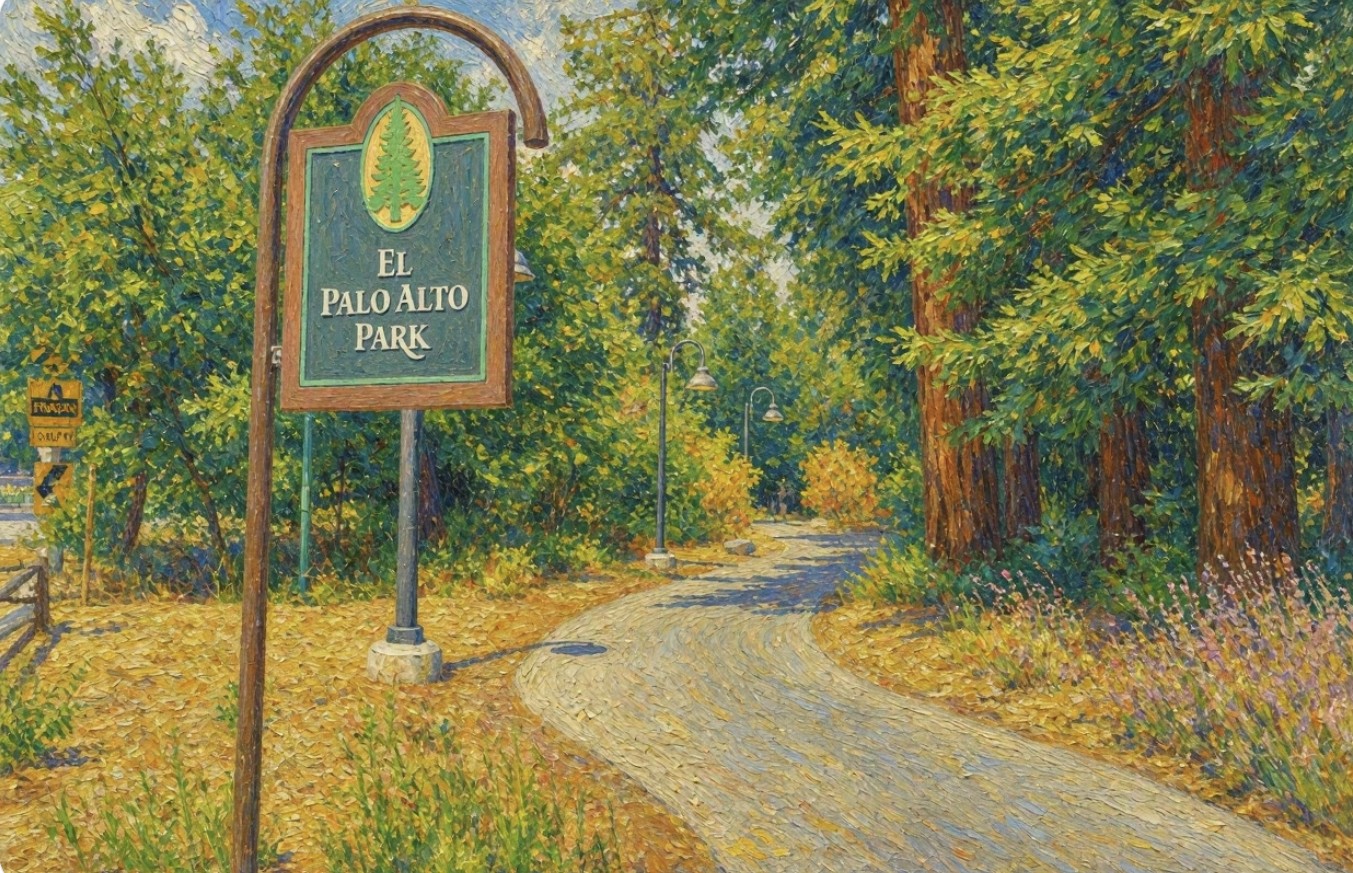
Palo Alto takes its name from a single coast redwood on the banks of San Francisquito Creek. Today, that same creek runs past one of the most resource-rich communities in the country. Stanford sits on the city’s edge, and research labs, nature preserves, and civic programs fill the rest of the map. For a motivated high school student, the opportunities are real and close to home.
That said, opportunity alone does not separate a Palo Alto applicant from the crowd. Thousands of local students have access to the same campus, the same labs, and the same advice. As a result, the students who stand out use these resources with unusual focus.

Palo Alto in the National Admissions Picture
California sends an enormous number of applicants to selective colleges, and the Bay Area sits at the center of that pool. Consequently, a Palo Alto student competes against a deep field of applicants with similar coursework and similar resumes. Admissions readers at highly selective schools know Gunn and Paly well. They expect rigorous transcripts from these schools, so a demanding schedule is the baseline rather than the differentiator.
Geography, in other words, offers little help here. Selective colleges value students from underrepresented regions, yet the Bay Area is anything but underrepresented. For students, the takeaway is simple: a local address opens doors to programs, not to admission. Geographic advantages only help students who have already built strong profiles. They matter most when a student uses them to go deep.
The Bay Area Default
Many families gravitate toward the same short list: Stanford, Berkeley, UCLA, and a handful of Ivies. This is Palo Alto’s version of local flagship anchor bias: nearby prestige becomes the default rather than a deliberate choice. However, a list built entirely on that default leaves students exposed if every reach falls through. Strong local applicants often find excellent fits at schools like Rice, Carnegie Mellon, Tufts, Washington University in St. Louis, and Pomona.
Early Decision also deserves attention. ED admit rates at many selective colleges run higher than regular-round rates, and Palo Alto’s regular pool is crowded. Therefore, a student with a clear first choice should evaluate ED during spring of junior year. Of course, an early application only works with a focused profile behind it. That is where the city itself becomes useful.
What Makes Palo Alto Distinctive
Palo Alto’s identity is often reduced to the HP Garage and the startup economy. Look a little closer, though, and the city offers far more specific material for students and essay writers.
The city’s namesake, El Palo Alto, still stands in El Palo Alto Park near the Caltrain tracks. This redwood is more than 1,000 years old. In November 1769, Spanish explorer Gaspar de Portolá’s expedition camped beside it. Today, it appears on both the city seal and Stanford’s seal. The creek banks around the tree were part of the Muwekma Ohlone homeland long before that expedition arrived. That history belongs first to the Ohlone community. Students outside it should approach it with respect rather than as essay material.
On the city’s eastern edge, the 1,940-acre Baylands Nature Preserve protects rare undisturbed marshland on San Francisco Bay. The preserve also serves as a major stopover on the Pacific Flyway. Meanwhile, Palo Alto neighborhoods hold one of the largest concentrations of Joseph Eichler’s mid-century modern homes. They offer a quiet record of the city’s postwar growth.
These details matter because precise, place-rooted writing stands out. A student who writes about restoring a creek bank or tracking shorebirds at the Baylands gives readers something new. Fortunately, several local programs put students directly into that kind of work. The first set sits a short bike ride away.

Research at Stanford That Welcomes Local Students
Stanford hosts dozens of high school programs, but a few are explicitly designed for nearby students. For Palo Alto teens, that local focus turns proximity into a practical advantage.
Stanford Young Investigators
The Stanford Doerr School of Sustainability runs Young Investigators, a summer research internship on the main campus. Interns work in research groups supervised by graduate students, postdocs, and lab managers. Options include oceans, geology, energy, environmental science and engineering, and social sciences. Group internships also cover fossil biodiversity and agriculture at the O’Donohue Family Stanford Educational Farm.
Eligibility is notably local. Applicants must have completed at least one year of high school. They must also live and attend school in the Bay Area within about 25 driving miles of campus. Participation is free; most interns are unpaid, although eligible students can receive an honorarium. Interns commit to roughly 20 hours per week over eight weeks. The program typically starts in mid-June and ends with final presentations in early August.
Applicants submit a teacher recommendation and a short introductory video. Competition is real: the program receives between 175 and 300 or more applications each year and accepts between 6 and 30 students. Additionally, transcripts and test scores are not required, so curiosity and commitment carry the application.
Pediatrics Internship Program at Stanford (PIPS)
PIPS offers an introduction to maternal and child health research with Stanford faculty, postdoctoral fellows, and researchers. The program targets students with little or no prior research experience. Each intern completes a research project over seven weeks, working 30 hours a week.
Applicants must be rising juniors or seniors and at least 16 by the program start. They must also live and attend high school in one of seven Bay Area counties, including Santa Clara and San Mateo. Students also need a cumulative unweighted GPA of at least 3.0. The application requires a resume, transcripts, and one recommendation from a science or math teacher. Participation itself costs nothing. Students with financial need can waive the $50 application fee and apply for a need-based stipend.
A Humanities-Minded Alternative: SHTEM
For students whose interests cross disciplines, the Stanford Compression Forum’s SHTEM internship blends science and engineering with the humanities. The program typically runs from June to August for current juniors and seniors who are U.S. citizens or permanent residents. However, SHTEM charges tuition ($2,500 dollars, with financial aid available), and applications are open from December to February.
Lab research is only one way to build depth, though. Some of Palo Alto’s most distinctive opportunities happen outdoors.

Restoration Work on Local Ground
Grassroots Ecology Youth Stewards
Grassroots Ecology, a Palo Alto-based nonprofit, restores habitat across Santa Clara and San Mateo counties. Its free Youth Stewards program began at the Pearson-Arastradero Preserve in 2011 and now runs cohorts at several local parks. Stewards meet once a week after school to remove invasive plants, care for wildlife habitat, and sharpen their observation skills alongside staff naturalists.
Requirements are simple: students need reliable transportation, a positive attitude, and willingness to do physical work outdoors. Winter, spring, and summer sessions are offered.
The real value here is continuity. One former steward described participating all four years of high school. A student who returns season after season can track how a restored site changes over time. That record makes for far more specific essay material than a single volunteer day. Similarly, the next set of programs rewards students who stay for the long haul.
Teaching, Mentoring, and Civic Voice
Palo Alto Junior Museum & Zoo Discovery Guides
The Junior Museum & Zoo opened in 1934 as the first children’s museum west of the Mississippi. In 2021, it reopened in a new facility. Its Discovery Guide volunteers lead interactive games and activities for visiting families. They also assist zoo staff with animal encounters and occasionally help with behind-the-scenes animal care.
The role is open to volunteers age 15 and older. Guides commit to volunteering monthly for at least one year, and applicants apply through the city’s volunteer application. For students interested in education, biology, or animal science, the role builds a lasting record of teaching and responsibility.
Palo Alto City Library Teen Library Advisory Board
The Palo Alto City Library’s Teen Library Advisory Board (TLAB) gives students in grades 8 through 12 a direct role in shaping teen services. Members advise on collections and spaces, co-create programs, and support citywide outreach events. Eligibility extends to students who live or study in Palo Alto or an adjoining city, such as Menlo Park or Mountain View.
TLAB operates on fall, winter/spring, and summer terms. Each term, members complete at least one activity, such as joining a planning team, assisting with a library program, or creating a booklist. After one semester in good standing, members can plan and present their own program with a staff mentor.

Building a Profile That Lasts
Selective colleges reward depth and sustained engagement far more than a long list of activities. In practice, that means choosing one or two genuine interests early and pursuing them across several years. It also means pairing them with the most rigorous coursework a student can handle well. A student who starts with Youth Stewards in ninth grade and applies to Young Investigators as a junior, for example, builds a coherent environmental science profile. Likewise, a TLAB member who eventually designs her own library program shows growth that admissions readers can see.
In the end, Palo Alto’s resources only help students who use them with intention. The city offers a thousand-year-old redwood, a protected marsh, and some of the world’s best research labs within a few miles. Students who engage deeply with a few of these opportunities give admissions readers a reason to remember them. Writing about that work with precision makes the impression last. College Transitions helps Palo Alto families build that kind of focused, nationally minded strategy, from course planning through the final application.

